

13 Jul 2026
Wavelength of Sodium Light by Fabry-Perot Interferometer
practical
pg-i
fabry-perot
interference
sodium-wavelength
Aim
To determine the wavelength of sodium light using a Fabry-Perot interferometer.
Apparatus
Sodium lamp, collimating lens, Fabry-Perot etalon, travelling microscope or telescope, and optical bench.
Experimental arrangement
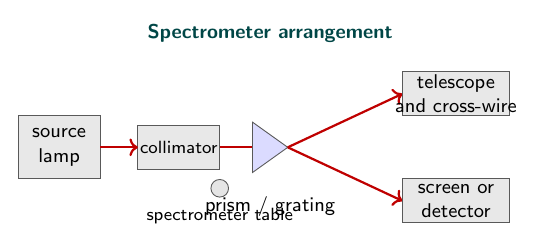
Theory
Multiple-beam interference occurs between successive transmissions through two parallel partially reflecting plates. For plate separation $t$, refractive index $\mu$, and internal angle $r$,
\[2\mu t\cos r=m\lambda.\]For two neighbouring rings of squared radii $D_m^2$ and $D_{m+p}^2$, the wavelength is obtained from their difference and the known focal length of the observing system.
Observations
| Ring pair | $D_m^2$ (cm$^2$) | $D_{m+5}^2$ (cm$^2$) |
|---|---|---|
| 1 | 4.20 | 8.12 |
| 2 | 5.06 | 8.98 |
| 3 | 6.01 | 9.94 |
Result
The mean value obtained from the ring measurements is approximately $\boxed{589\,\text{nm}}$ for sodium light.
Viva Questions
- Why are many beams involved? The plates produce repeated partial transmissions.
- Why are rings observed? Equal inclination produces circular loci in the viewing field.
- Why is Fabry-Perot highly resolving? Multiple-beam interference gives narrow, sharp maxima.


Discussion