

13 Jul 2026
Wavelength of Laser Light by Plane Diffraction Grating
Aim
To determine the wavelength of a laser using a plane transmission diffraction grating.
Apparatus
Laser, plane grating, screen, metre scale, grating holder, and optical bench.
Experimental arrangement
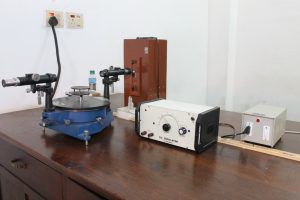
Theory
A grating has a large number of equally spaced transparent slits. Waves from successive slits interfere constructively when the path difference is an integral multiple of the wavelength. For normal incidence,
\[d\sin\theta=n\lambda,\]where $d$ is the grating element, $n$ is the order, and $\theta$ is the diffraction angle. If the distance from grating to screen is $D$ and the distance of the $n$th order from the central maximum is $x$, then $\tan\theta=x/D$.
Observations
| Order $n$ | Left distance (cm) | Right distance (cm) | Mean $x$ (cm) |
|---|---|---|---|
| 1 | 18.4 | 18.6 | 18.5 |
| 2 | 38.5 | 38.7 | 38.6 |
| 3 | 64.1 | 64.3 | 64.2 |
With $d=1/600000$ m and $D=100$ cm, the mean wavelength is approximately $650$ nm.
Result
The wavelength of the laser is approximately $\boxed{650\,\text{nm}}$.
Viva Questions
- Why are readings taken on both sides? To reduce error in locating the central maximum and diffraction orders.
- What is grating element? The sum of the slit width and opaque spacing.
- Why does the central maximum have order zero? Its path difference is zero.


Discussion