

13 Jul 2026
Resolving Power of a Prism
Aim
To determine the resolving power of a prism by observing two nearby spectral lines.
Apparatus
Spectrometer, high-dispersion prism, sodium or mercury lamp, narrow slit, collimator, telescope, and reading lens.
Experimental arrangement
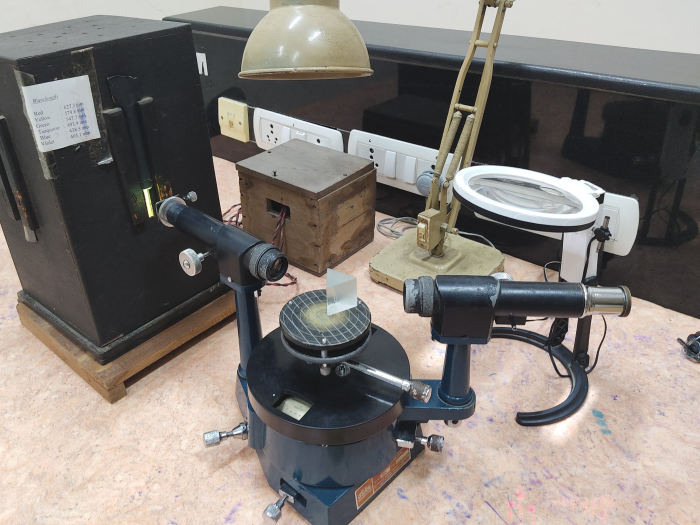
Theory
Light entering a prism is refracted because its speed changes at the glass-air boundary. Since the refractive index depends on wavelength, two nearby wavelengths emerge at slightly different deviations. The instrument can distinguish the lines only when the two broadened images are sufficiently separated.
The resolving power of a prism is the ratio $R=\lambda/\Delta\lambda$, where $\Delta\lambda$ is the smallest wavelength separation that can just be distinguished. Two lines are considered just resolved when the maximum of one overlaps the first minimum of the other according to the Rayleigh criterion. A larger base angle, greater dispersion, and longer effective path in the prism improve resolution.
Observations
| Spectral pair | Wavelengths (nm) | Observation |
|---|---|---|
| mercury yellow doublet | 577.0, 579.1 | just resolved |
| sodium doublet | 589.0, 589.6 | not resolved |
For the mercury pair, $\lambda=578.05$ nm and $\Delta\lambda=2.1$ nm.
Result
The prism resolves the mercury yellow pair but does not resolve the closer sodium doublet under the present adjustment. The resolving power for the mercury pair is approximately $R=275$.
Viva Questions
- What is resolving power? $R=\lambda/\Delta\lambda$.
- Why is a narrow slit used? It reduces geometrical broadening of the spectral image.
- What is the Rayleigh criterion? Two lines are just resolved when the principal maximum of one coincides with the first minimum of the other.


Discussion