

13 Jul 2026
Resolving Power of an Astronomical Telescope
Aim
To determine the resolving power of a telescope using two closely separated illuminated objects.
Apparatus
Astronomical telescope, two illuminated pinholes or double-star simulator, micrometer arrangement, and measuring scale.
Experimental arrangement
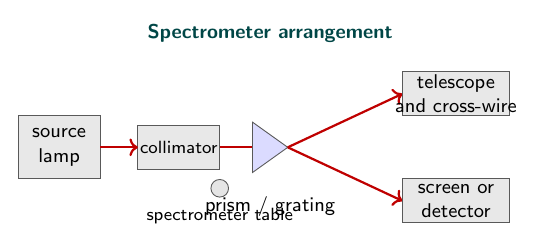
Theory
Light from a point object reaches the objective as an approximately plane wave. Because the objective has a finite circular aperture, the wave is diffracted and forms an Airy pattern rather than a geometrical point image. Two close stars can be distinguished only when their diffraction patterns are sufficiently separated. Using the Rayleigh criterion for a circular aperture of diameter $D$, the minimum angular separation for just resolution is
\[\theta_{min}=1.22\frac{\lambda}{D}.\]The resolving power is the ability to distinguish small angular separations. Thus, when the angle is expressed in radians,
\[R=\frac{1}{\theta_{min}}=\frac{D}{1.22\lambda}.\]The objective diameter improves resolution, whereas a longer wavelength makes the diffraction disc wider and reduces it.
Observations
| Aperture $D$ (cm) | Wavelength (nm) | Minimum angular separation (arcsec) |
|---|---|---|
| 5.0 | 589 | 2.97 |
| 7.5 | 589 | 1.98 |
| 10.0 | 589 | 1.49 |
Result
The resolving power increases with telescope aperture and follows the diffraction relation.
Viva Questions
- What limits telescope resolution? Diffraction at the objective aperture.
- What is the Rayleigh criterion? The central maximum of one image coincides with the first minimum of the other.
- Why is a larger objective useful? It reduces the diffraction angular width.


Discussion