

13 Jul 2026
Thickness of a Thin Wire by Laser Diffraction
practical
pg-i
laser
diffraction
thin-wire
Aim
To determine the diameter of a thin wire using the diffraction pattern produced by a laser.
Apparatus
Laser, thin wire, screen, metre scale, wire holder, and optical bench.
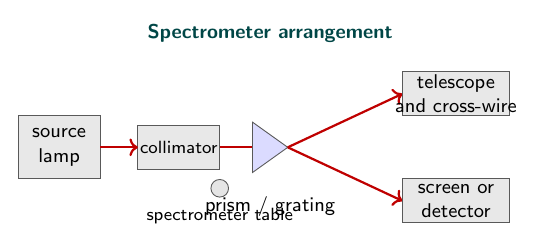
Experimental arrangement
Theory
By Babinet’s principle, the diffraction pattern of a thin opaque wire has the same positions of minima as a slit of width equal to the wire diameter $a$. For a screen distance $D$ and distance $x_n$ of the $n$th minimum from the centre,
\[a\frac{x_n}{D}=n\lambda,\]for small angles. Hence $a=n\lambda D/x_n$.
Observations
| Minimum order $n$ | Distance from centre $x_n$ (cm) | Screen distance $D$ (cm) |
|---|---|---|
| 1 | 2.60 | 100 |
| 2 | 5.20 | 100 |
| 3 | 7.80 | 100 |
For $\lambda=650$ nm, the diameter is approximately $0.025$ mm.
Result
The diameter of the wire is approximately $\boxed{0.025\,\text{mm}}$.
Viva Questions
- Why can Babinet’s principle be used? The complementary wire and slit have the same diffraction intensity away from the geometrical image.
- Why is a laser preferred? It is monochromatic and highly directional.
- What causes the dark bands? Destructive interference of secondary wavelets.


Discussion