

13 Jul 2026
Verification of Basic Logic Gates Using NAND and NOR Gates
Aim
To verify the truth tables of AND, OR, NOT, NAND, NOR, and XOR gates and realise basic gates using universal gates.
Apparatus
Digital logic trainer, IC 7400 or 7410, IC 7402, regulated $5$ V supply, patch cords, switches, and LED indicators.
Experimental arrangement
Theory
Digital circuits assign ranges of voltage to the logical states 0 and 1. A gate implements a Boolean function: AND gives $AB$, OR gives $A+B$, and NOT gives $\overline A$. NAND and NOR add inversion to AND and OR, while XOR is one only when the inputs differ:
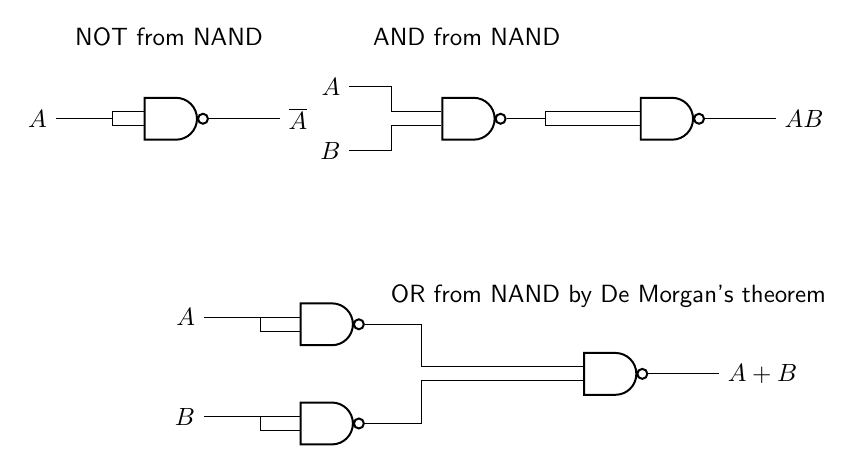
\[Y_{XOR}=A\oplus B=\overline AB+A\overline B.\]A gate set is universal if every Boolean function can be built from that gate alone. Connecting both inputs of a NAND gate to $A$ gives
\[A\ \text{NAND}\ A=\overline{AA}=\overline A,\]so NAND first supplies inversion. NAND followed by this inverter gives AND:
\[\overline{\overline{AB}}=AB.\]De Morgan’s theorem gives the NAND-only OR realisation:
\[A+B=\overline{\overline A\,\overline B}.\]Similarly, NOR with its inputs joined gives NOT; inversion of a NOR output gives OR, and De Morgan’s theorem then gives AND. The LED indicator must be connected through a resistor, and unused TTL inputs must be tied to a defined logic level.
Observations
| $A$ | $B$ | AND | OR | NAND | NOR | XOR |
|---|---|---|---|---|---|---|
| 0 | 0 | 0 | 0 | 1 | 1 | 0 |
| 0 | 1 | 0 | 1 | 1 | 0 | 1 |
| 1 | 0 | 0 | 1 | 1 | 0 | 1 |
| 1 | 1 | 1 | 1 | 0 | 0 | 0 |
Verification
For $A=0$ and $B=1$,
\[\text{NAND}=\overline{0\cdot1}=1,\qquad \text{NOR}=\overline{0+1}=0,\]and
\[\text{XOR}=\overline0(1)+0(\overline1)=1.\]These values match the second observation row.
Result
The truth tables are verified, and the basic gates are realised from NAND/NOR universal gates.
Viva Questions
- Why is NAND universal? NOT, AND, and OR can all be formed using NAND gates alone.
- What is XOR output for equal inputs? Zero.
- Why must unused TTL inputs not be left floating? Their logic state may become undefined and produce unreliable output.


Discussion