

13 Jul 2026
B-H Loop and Hysteresis Loss of a Ferromagnetic Core
Aim
To plot the B-H loop of a ferromagnetic sample and determine its retentivity, coercivity, and hysteresis loss per unit volume per cycle.
Apparatus
Ferromagnetic ring or transformer core, primary and secondary coils, AC supply, CRO, integrating circuit, rheostat, and voltmeter.
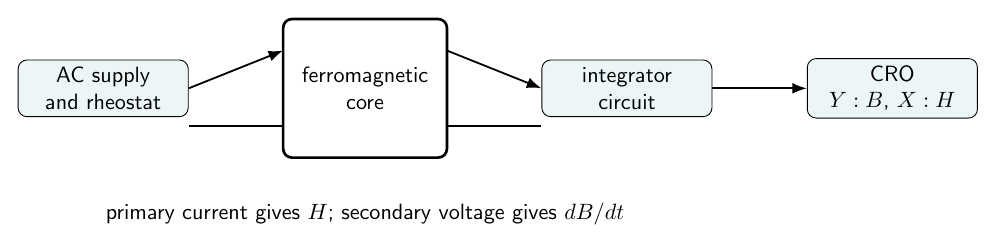
Experimental arrangement
Theory
The current in the primary coil produces a magnetising field $H$ inside the ferromagnetic core. The changing magnetic flux through the secondary coil induces a voltage proportional to $dB/dt$. An integrator converts this signal into a voltage proportional to $B$. The CRO therefore displays $B$ vertically against $H$ horizontally.
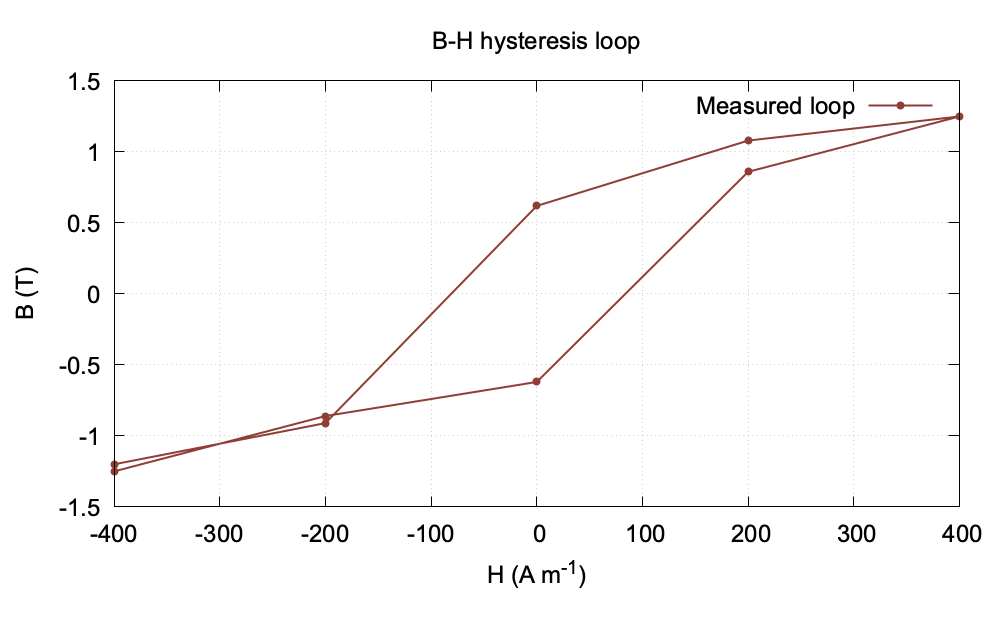
When the field is cycled, the magnetic domains do not return to their original arrangement along the same path. The material retains induction when $H=0$; this is retentivity. A reverse field is required to make $B=0$; this is coercivity. The area enclosed by the B-H loop equals the hysteresis energy loss per unit volume per cycle:
\[W_h=\oint H\,dB.\]Observations
| $H$ (A m$^{-1}$) | $B$ on increasing field (T) | $B$ on decreasing field (T) |
|---|---|---|
| 0 | 0.00 | 0.62 |
| 100 | 0.48 | 0.73 |
| 200 | 0.86 | 0.91 |
| 300 | 1.10 | 1.08 |
| 400 | 1.25 | 1.20 |
Retentivity: $B_r=0.62$ T; coercivity: $H_c=95$ A m$^{-1}$.
Graph
Calculation
The loop area obtained by graphical integration is approximately $0.18$ J m$^{-3}$ per cycle for the supplied sample.
Result
\[\boxed{B_r=0.62\text{ T}},\qquad \boxed{H_c=95\text{ A m}^{-1}},\qquad \boxed{W_h\approx0.18\text{ J m}^{-3}\text{ cycle}^{-1}}.\]Viva Questions
- What is retentivity? It is the induction retained when the applied magnetising field is reduced to zero.
- What is coercivity? It is the reverse field needed to reduce the residual induction to zero.
- What does the loop area represent? Hysteresis energy loss per unit volume per cycle.


Discussion