

13 Jul 2026
Dielectric Constant of Solid and Liquid Samples by Capacitance Method
Aim
To determine the dielectric constant of solid and liquid samples by measuring the capacitance of a parallel-plate capacitor.
Apparatus
Parallel-plate capacitor, LCR meter, solid dielectric sheets, liquid cell, micrometer, connecting leads, and insulating supports.
Experimental arrangement
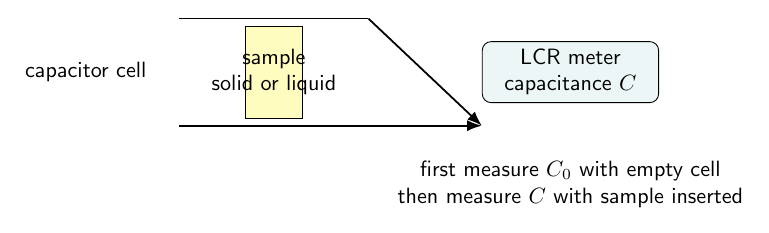
Theory
Two conducting plates separated by distance $d$ store equal and opposite charges when a potential difference is applied. In air or vacuum, the capacitance is
\[C_0=\frac{\epsilon_0A}{d}.\]When an insulating material is placed between the plates, its molecules polarise. The induced dipoles reduce the effective electric field for a given charge, so a larger charge is required to maintain the same voltage. The capacitance becomes
\[C=\frac{\epsilon_r\epsilon_0A}{d}=\epsilon_r C_0.\]Therefore the relative permittivity or dielectric constant is
\[\epsilon_r=\frac{C}{C_0}.\]For a liquid, the empty-cell capacitance is first measured and the cell is then filled without air bubbles. The same capacitance ratio is used after allowing the liquid to settle.
Observations
Empty-cell capacitance: $C_0=48$ pF.
| Sample | Filled capacitance $C$ (pF) | Dielectric constant $\epsilon_r$ |
|---|---|---|
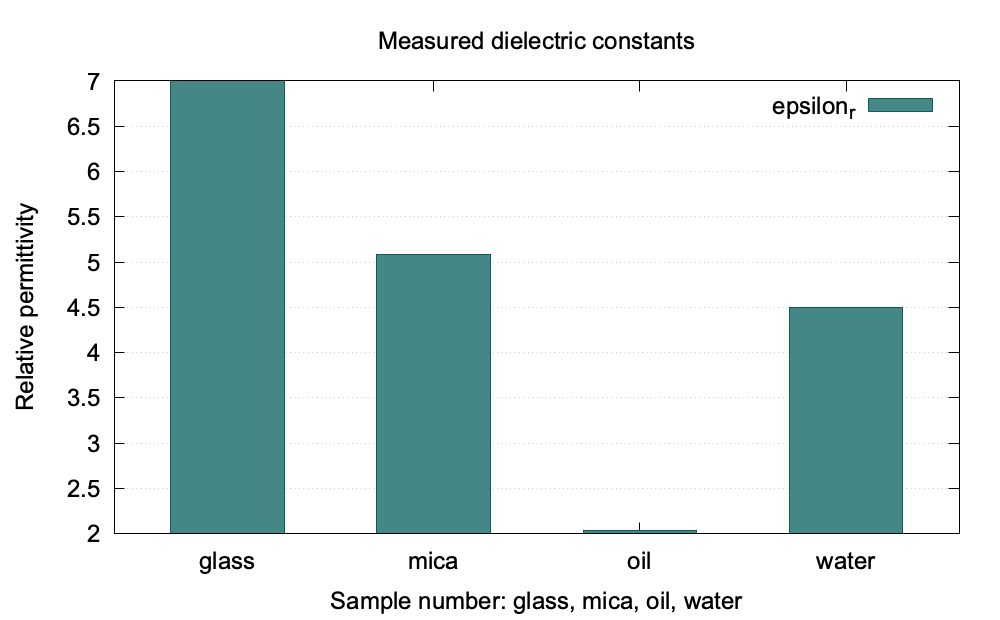
| Glass | 336 | 7.00 |
| Mica | 244 | 5.08 |
| Transformer oil | 98 | 2.04 |
| Distilled water | 216 | 4.50 |
Graph
Calculation
For glass,
\[\epsilon_r=\frac{C}{C_0}=\frac{336}{48}=7.00.\]Result
The dielectric constants are
\[\boxed{\epsilon_r(\text{glass})=7.00},\qquad \boxed{\epsilon_r(\text{mica})=5.08},\qquad \boxed{\epsilon_r(\text{oil})=2.04}.\]Viva Questions
- What is dielectric polarisation? It is the displacement or alignment of bound charges inside an insulating material.
- Why must air bubbles be removed from the liquid cell? They introduce a second dielectric and alter the effective capacitance.
- Why is an LCR meter used? It measures capacitance at a controlled AC frequency.


Discussion