

13 Jul 2026
Determination of Magnetic Field Strength and Resonance Frequency Using ESR
Aim
To determine the resonance frequency and magnetic field strength of a paramagnetic sample using electron spin resonance, and to calculate the electron $g$-factor.
Apparatus
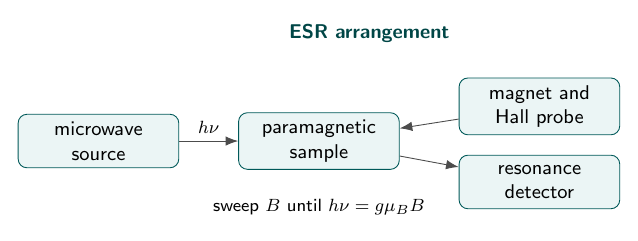
ESR spectrometer, microwave source, Helmholtz coils, Hall probe, paramagnetic sample, and frequency meter.
Figure
Theory
An atom or ion with an unpaired electron possesses a spin magnetic moment. In an applied magnetic field the two allowed orientations of the electron spin have different energies; this Zeeman splitting is
\[\Delta E=g\mu_BB.\]When microwave radiation is applied, the spin can change orientation if one microwave quantum supplies exactly this energy. Resonance therefore occurs when
\[h\nu=g\mu_BB.\]Measuring the resonant field at a known frequency gives
\[g=\frac{h\nu}{\mu_BB}.\]The spectrometer sweeps the magnetic field through resonance and records the field at which the absorption peak occurs.
Observations
| Microwave frequency (GHz) | Resonance field (mT) | $g$ |
|---|---|---|
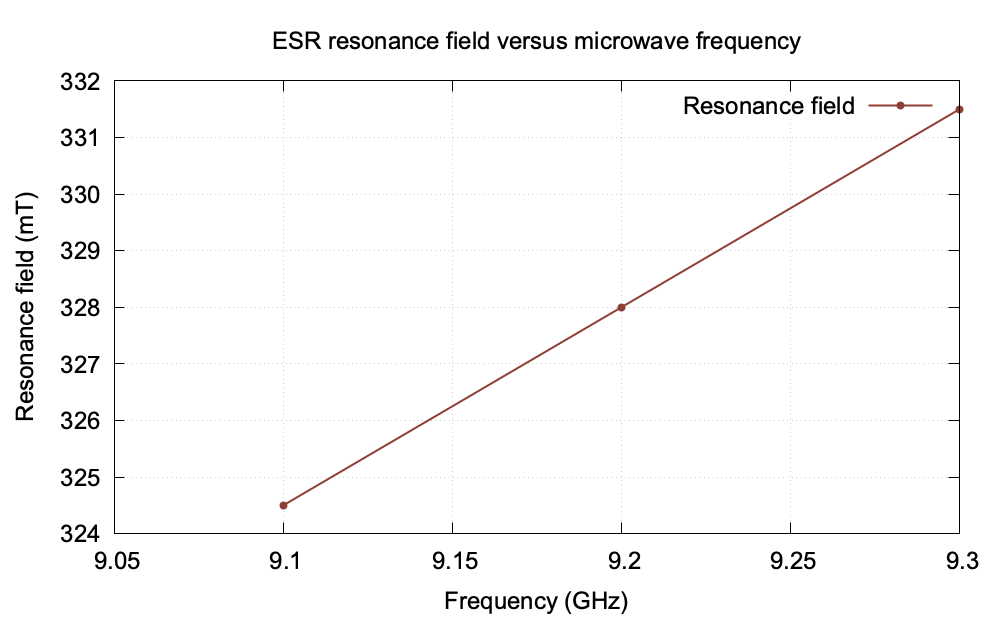
| 9.10 | 324.5 | 2.00 |
| 9.20 | 328.0 | 2.01 |
| 9.30 | 331.5 | 2.00 |
Graph
Result
The resonance condition is observed by sweeping the magnetic field at each microwave frequency. The mean electron $g$-factor of the sample is
\[\boxed{g=2.00}.\]Viva Questions
- Why is a paramagnetic sample used? It contains unpaired spins that can absorb microwave energy.
- What is resonance? Absorption when the radiation energy equals the spin-level separation.
- Why is a Hall probe used? To calibrate the magnetic field at the sample position.


Discussion