

13 Jul 2026
Hall Coefficient, Carrier Type, and Hall Angle of a Semiconductor
Aim
To determine the Hall coefficient, identify the type of charge carriers, and calculate the Hall angle of a semiconductor.
Apparatus
Hall-effect sample, electromagnet, constant-current source, microvoltmeter, Gauss meter, and micrometer.
Experimental arrangement
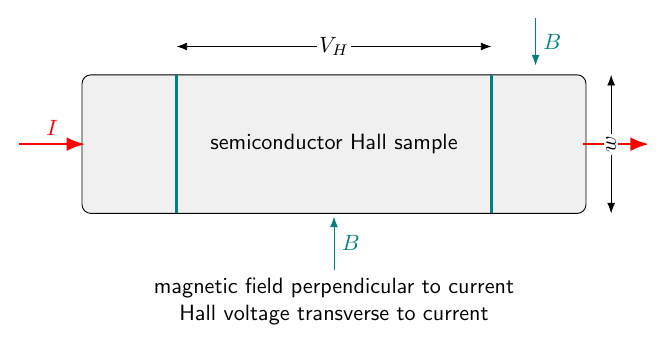
Theory
Moving charge carriers experience the Lorentz force in a magnetic field. In a rectangular sample carrying current along the $x$-direction, the magnetic force pushes carriers towards one side. The resulting transverse electric field grows until the electric and magnetic forces balance. This field produces the Hall voltage $V_H$.
For sample thickness $t$, current $I$, and magnetic field $B$,
\[R_H=\frac{V_Ht}{IB}.\]The sign of $R_H$ identifies the dominant carriers. If $V_x$ is the longitudinal voltage between contacts separated by $L$, and the Hall contacts are separated by width $w$, the Hall angle is
\[\tan\theta_H=\frac{E_H}{E_x}=\frac{V_H/w}{V_x/L}=\frac{LV_H}{wV_x}.\]| For one dominant carrier type, the concentration is $n=1/(e | R_H | )$. |
Observations
Sample thickness $t=0.50$ mm, contact separation $L=10$ mm, width $w=5$ mm, and current $I=5$ mA.
| Magnetic field (T) | Hall voltage (mV) | Longitudinal voltage $V_x$ (mV) | Hall angle (degree) |
|---|---|---|---|
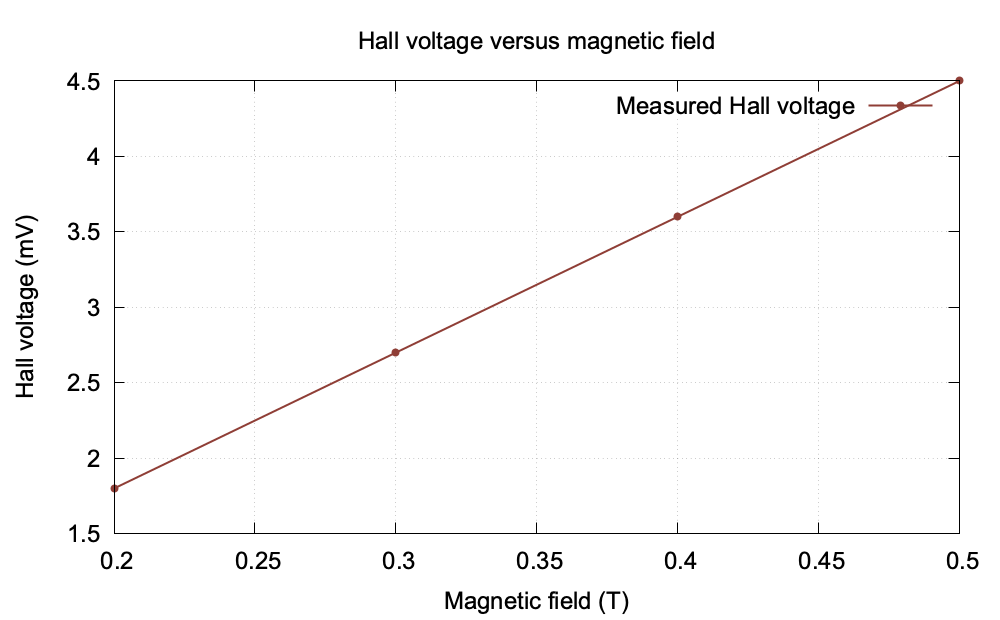
| 0.20 | 1.8 | 180 | 1.15 |
| 0.30 | 2.7 | 180 | 1.72 |
| 0.40 | 3.6 | 180 | 2.29 |
| 0.50 | 4.5 | 180 | 2.86 |
Graph
Calculation
For $B=0.40$ T and $V_H=3.6$ mV,
\[R_H=\frac{(3.6\times10^{-3})(0.50\times10^{-3})}{(5\times10^{-3})(0.40)}=9.00\times10^{-4}\ \mathrm{m^3C^{-1}}.\]Also,
\[\tan\theta_H=\frac{(10)(3.6)}{(5)(180)}=0.040,\]so $\theta_H=2.29^\circ$.
Result
\[\boxed{R_H=9.00\times10^{-4}\ \mathrm{m^3C^{-1}}},\qquad \boxed{\theta_H=2.29^\circ}.\]The positive Hall coefficient indicates a p-type sample.
Viva Questions
- What causes Hall voltage? The sideways Lorentz force on moving charge carriers.
- What does the sign of Hall coefficient show? It identifies whether electrons or holes dominate conduction.
- What is Hall angle? The angle between the total electric field and the longitudinal electric field in a magnetic field.


Discussion