

13 Jul 2026
Normal Modes and Dispersion in a Coupled-Oscillator Lattice Model
Aim
To study the normal modes of a one-dimensional coupled-oscillator model and relate the measured frequencies to lattice vibrations in a crystal.
Apparatus and software
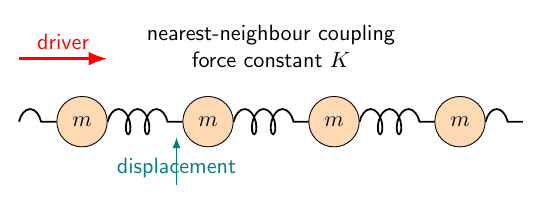
Coupled-mass spring model or computer simulation, vibration driver, displacement sensor, frequency generator, and plotting software.
Experimental arrangement
Theory
In a crystal, atoms are arranged about equilibrium positions and interact through interatomic forces. If one atom is displaced, the change in force affects its neighbours. A chain of equal masses $m$ joined by springs of force constant $K$ is therefore a useful model of lattice vibrations.
For a displacement $u_n$ of the $n$th mass,
\[m\frac{d^2u_n}{dt^2}=K(u_{n+1}+u_{n-1}-2u_n).\]Putting $u_n=u_0e^{i(nqa-\omega t)}$ gives the dispersion relation
\[\omega(q)=2\sqrt{\frac{K}{m}}\left|\sin\frac{qa}{2}\right|,\]where $a$ is the equilibrium spacing and $q$ is the wave number. Each allowed pattern has one frequency and fixed relative amplitudes; it is a normal mode. The low-$q$ modes are acoustic-like, while higher modes have more nodes and shorter wavelengths.
Observations
| Mode number | Relative frequency | Number of phase reversals | Nature of motion |
|---|---|---|---|
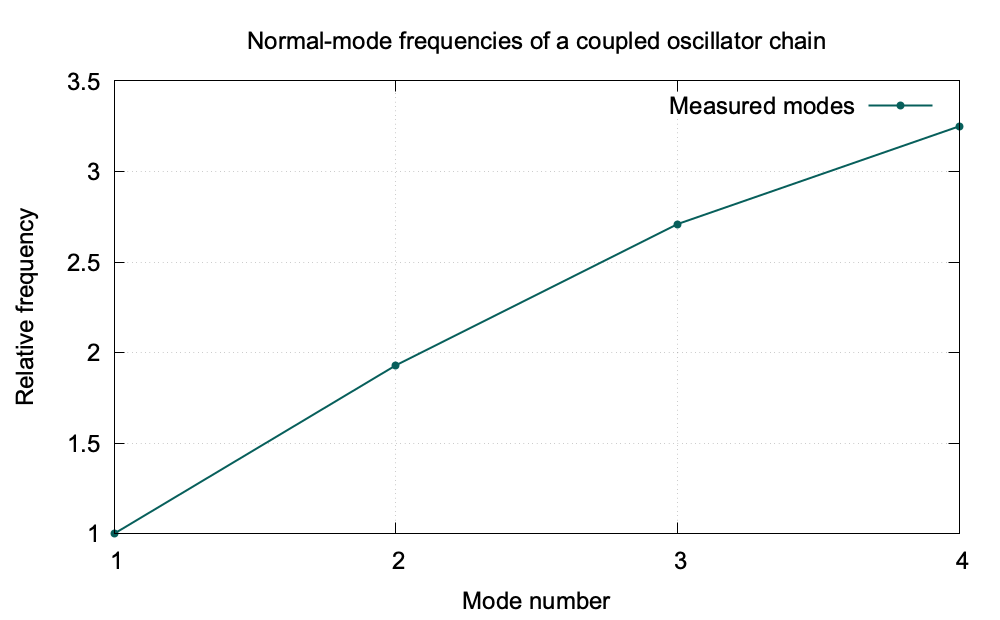
| 1 | 1.00 | 0 | all masses nearly in phase |
| 2 | 1.93 | 1 | one node develops |
| 3 | 2.71 | 2 | two phase reversals |
| 4 | 3.25 | 3 | shortest wavelength mode |
Graph
Calculation
The measured frequency of mode 2 relative to mode 1 is
\[\frac{f_2}{f_1}=\frac{1.93}{1.00}=1.93.\]The increasing frequency and increasing number of phase reversals confirm the normal-mode behaviour of the coupled system.
Result
The coupled oscillator possesses discrete normal modes. Higher modes have more nodes and higher frequencies, as expected for a one-dimensional lattice model.
Viva Questions
- What is a normal mode? A collective oscillation in which all particles vibrate at one frequency with fixed amplitude ratios.
- What provides the restoring force? The change in interatomic potential energy when neighbouring atoms are displaced.
- What is a phonon? The quantum of energy associated with a normal mode of lattice vibration.


Discussion