

13 Jul 2026
Determination of e/m by the Helical Method
Aim
To determine the specific charge of the electron by observing the helical path of an electron beam in a magnetic field.
Apparatus
Electron-beam tube, Helmholtz coils, DC supplies, voltmeters, ammeters, and measuring scale.
Experimental arrangement
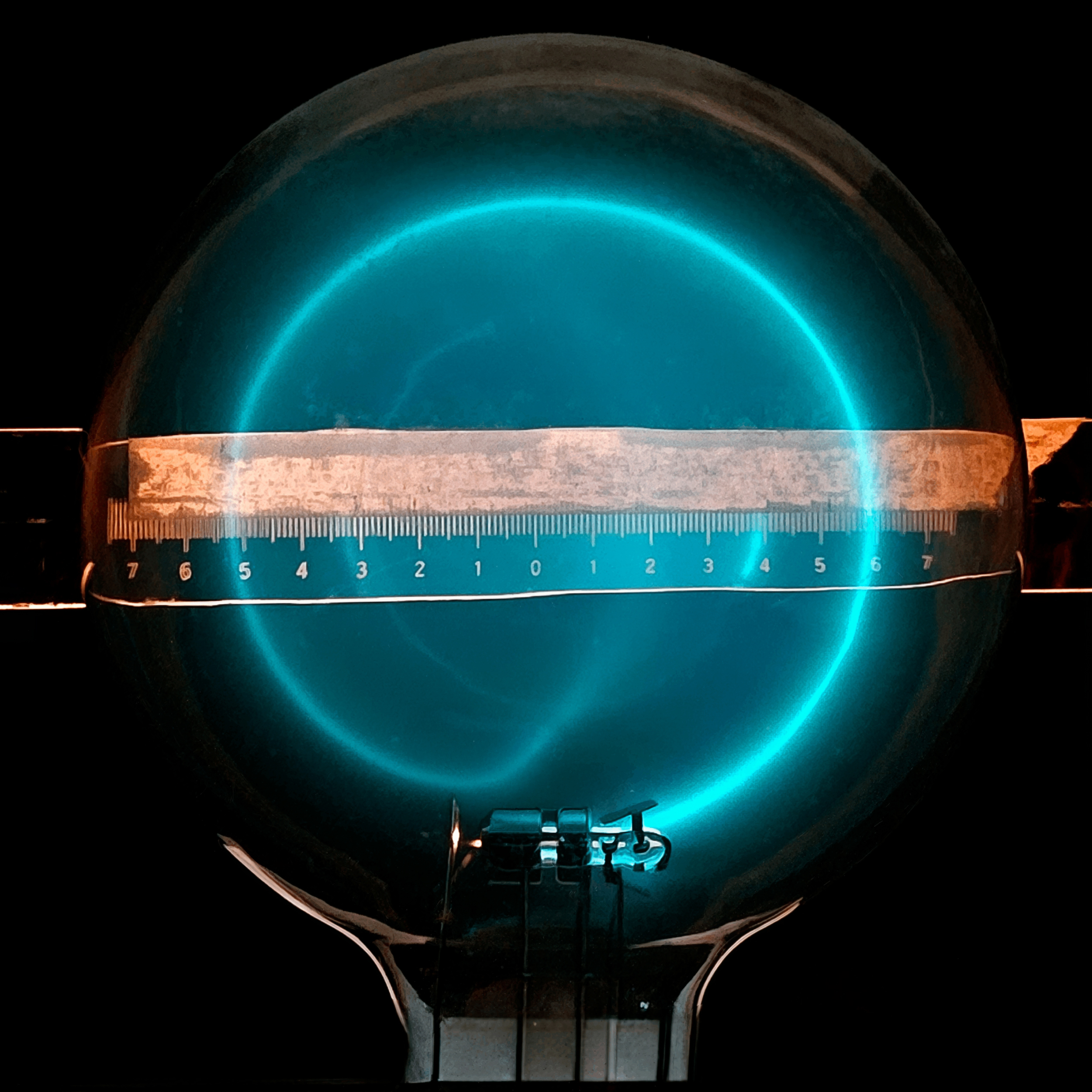
Apparatus photograph: Wikimedia Commons.
Theory
Electrons are emitted inside the electron-beam tube and accelerated through the potential difference $V$. The electrical work becomes kinetic energy,
\[eV=\frac{1}{2}mv^2.\]The beam then enters the nearly uniform magnetic field produced by the Helmholtz coils. For coils of radius $R$ separated by $R$, the field near the midpoint is approximately
\[B=\left(\frac{4}{5}\right)^{3/2}\frac{\mu_0NI_c}{R},\]where $I_c$ is the coil current. The magnetic force on the electron is
\[\mathbf F=-e(\mathbf v\times\mathbf B).\]It is always perpendicular to the instantaneous velocity, so it changes the direction of motion but not the speed. If the beam enters at an angle $\alpha$ to the field, its velocity has components $v_\perp=v\sin\alpha$ and $v_\parallel=v\cos\alpha$. The perpendicular component produces circular motion of radius $r$, while the parallel component carries the electron forward. The combined path is a helix.
For the circular part, $ev_\perp B=mv_\perp^2/r$, so $r=mv_\perp/(eB)$. One complete turn takes $T=2\pi m/(eB)$ and the distance advanced in one turn is the pitch
\[p=v_\parallel T=\frac{2\pi m v_\parallel}{eB}.\]Since $v^2=v_\perp^2+v_\parallel^2$, elimination of the velocity gives the working relation
\[\boxed{\frac{e}{m}=\frac{2V}{B^2\left[r^2+\left(\frac{p}{2\pi}\right)^2\right]}}.\]For a circular beam $p=0$, this reduces to $e/m=2V/(B^2r^2)$.
Observations
| Accelerating voltage $V$ (V) | Diameter $2r$ (cm) | Pitch $p$ (cm) | Field $B$ (mT) |
|---|---|---|---|
| 180 | 5.8 | 2.4 | 1.555 |
| 220 | 6.4 | 2.7 | 1.555 |
| 260 | 6.9 | 3.0 | 1.555 |
| 300 | 7.4 | 3.2 | 1.555 |
Calculation
For the first reading, $r=2.9$ cm, $p=2.4$ cm, and $B=1.555$ mT. On converting centimetres and millitesla into SI units,
\[\frac{e}{m}=\frac{2(180)}{(1.555\times10^{-3})^2\left[(0.029)^2+\left(\frac{0.024}{2\pi}\right)^2\right]}=1.74\times10^{11}\ \mathrm{C\,kg^{-1}}.\]The same calculation is repeated for every reading. The mean of the four values is $1.76\times10^{11}\ \mathrm{C\,kg^{-1}}$.
Result
The calculated mean value of the specific charge is
\[\boxed{\frac{e}{m}=1.76\times10^{11}\ \mathrm{C\,kg^{-1}}}.\]Viva Questions
- Why are Helmholtz coils used? They provide a nearly uniform magnetic field near the centre.
- Why is the path helical? The velocity has both perpendicular and parallel components relative to the field.
- What happens if the beam velocity is perpendicular to the field? The path becomes circular.


Discussion