

14 Jul 2026
Truncation, Round-Off, Absolute and Relative Errors
Aim
To study truncation error, round-off error, absolute error, relative error, and percentage error using simple numerical observations.
Apparatus
Calculator, graph paper or plotting software, and observation notebook.
Figure
Principle
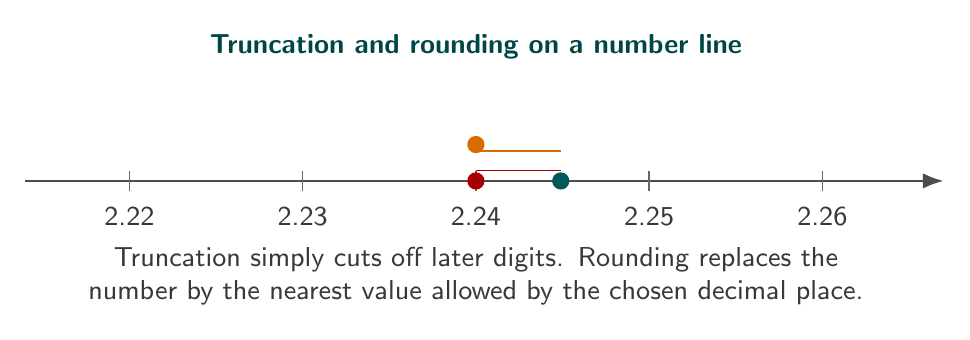
In experimental physics, no measured value is exact. A numerical value may be shortened by truncation or by rounding. Truncation means cutting off digits after a chosen decimal place. Rounding means replacing the value by the nearest number available at the chosen decimal place.
If $x$ is the true value and $x_m$ is the measured or approximate value, then
\[\text{absolute error}=|x-x_m|,\] \[\text{relative error}=\frac{|x-x_m|}{x},\]and
\[\text{percentage error}=\frac{|x-x_m|}{x}\times 100.\]Observation
Let the true value be
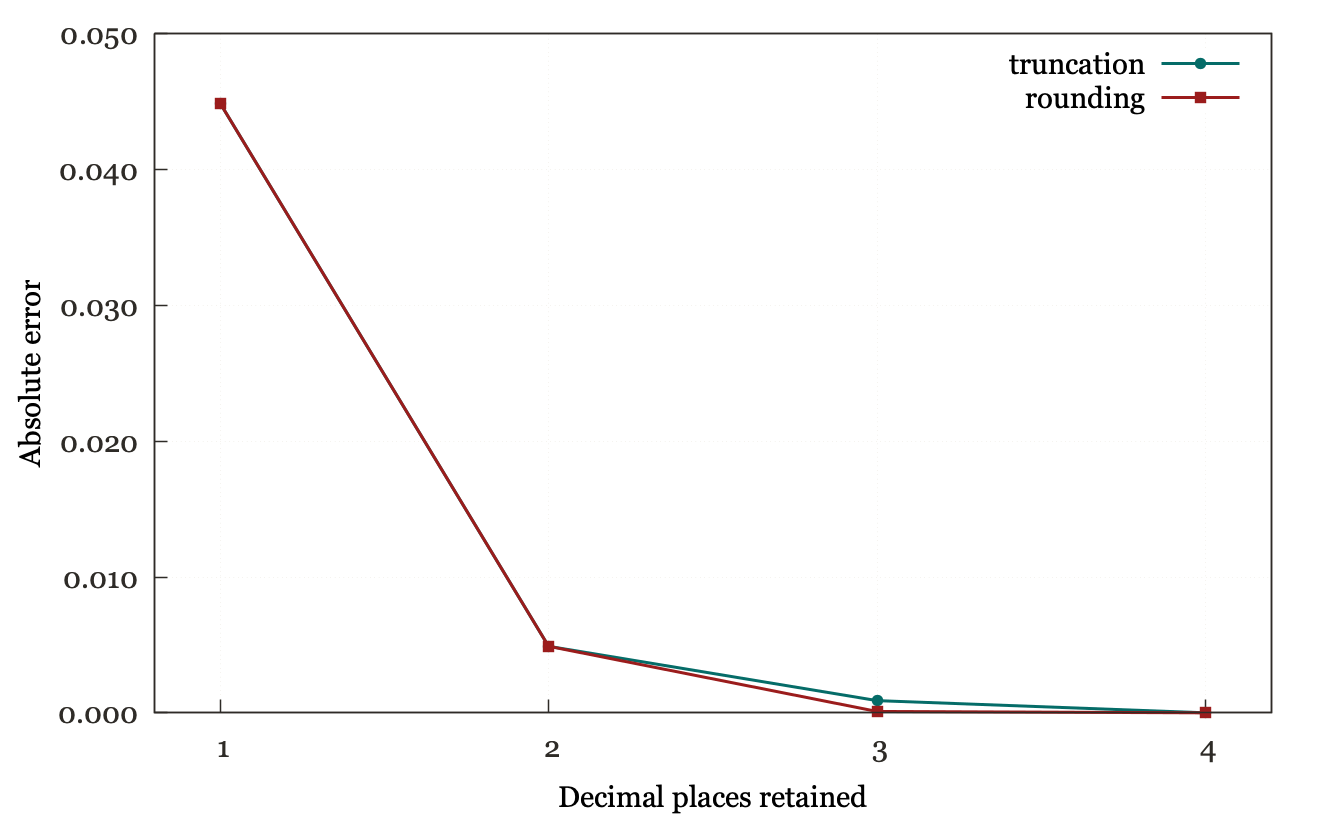
\[x=2.2449.\]| Decimal places retained | Truncated value | Rounded value | Absolute error in truncation | Absolute error in rounding |
|---|---|---|---|---|
| 1 | 2.2 | 2.2 | 0.0449 | 0.0449 |
| 2 | 2.24 | 2.24 | 0.0049 | 0.0049 |
| 3 | 2.244 | 2.245 | 0.0009 | 0.0001 |
| 4 | 2.2449 | 2.2449 | 0.0000 | 0.0000 |
Graph
Calculation
For two decimal places,
\[x=2.2449,\qquad x_m=2.24.\]Hence,
\[\Delta x=|2.2449-2.24|=0.0049.\]The relative error is
\[\frac{\Delta x}{x}=\frac{0.0049}{2.2449}=0.00218.\]The percentage error is therefore
\[0.00218\times100=0.218\%.\]Result
The error decreases when more decimal places are retained. For the value $2.2449$, rounding to three decimal places gives a smaller error than truncating to three decimal places.
Precautions
- Keep the same number of decimal places while comparing values.
- Do not round intermediate steps too early.
- Write units with measured quantities.
- Use absolute error for size of error and relative error for comparison of accuracy.
Viva Questions
-
What is truncation?
Truncation is the removal of digits after a chosen decimal place without considering the next digit. -
What is round-off?
Round-off is the replacement of a number by the nearest value at a chosen decimal place. -
Why is relative error useful?
It compares the error with the size of the measured quantity, so it is useful for judging accuracy. -
Can absolute error be zero?
Yes, if the measured or approximate value is exactly equal to the true value. -
Why should final answers not contain too many insignificant digits?
Extra digits may give a false impression of accuracy.
Maxima Code
The calculation can be checked with this file: errors-round-off-calculation.mac.


Discussion