

14 Jul 2026
Acceleration Due to Gravity by Kater's Pendulum
Aim
To determine the acceleration due to gravity $g$ using Kater’s reversible pendulum.
Apparatus
Kater’s pendulum, rigid support with knife-edge rest, stop watch, metre scale, and movable mass.
Figure
Principle
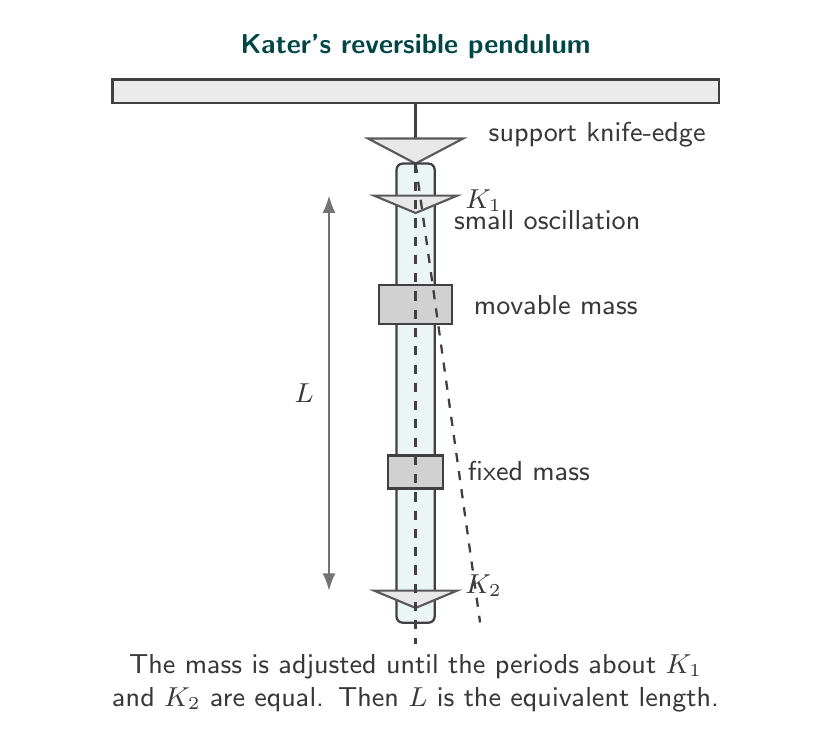
Kater’s pendulum is a reversible compound pendulum. It has two knife-edges, $K_1$ and $K_2$. The position of the movable mass is adjusted until the time periods about the two knife-edges are equal. At this condition, the distance between the two knife-edges is the equivalent length $L$ of a simple pendulum.
For a simple pendulum of equivalent length $L$ and time period $T$,
\[T=2\pi\sqrt{\frac{L}{g}}.\]Therefore,
\[g=\frac{4\pi^2L}{T^2}.\]Observations
Distance between knife-edges:
\[L=99.4\text{ cm}=0.994\text{ m}.\]| Position of movable mass (cm) | Time for 20 oscillations about $K_1$ (s) | $T_1$ (s) | Time for 20 oscillations about $K_2$ (s) | $T_2$ (s) |
|---|---|---|---|---|
| 18 | 40.50 | 2.025 | 39.44 | 1.972 |
| 20 | 40.26 | 2.013 | 39.68 | 1.984 |
| 22 | 40.04 | 2.002 | 39.92 | 1.996 |
| 24 | 39.82 | 1.991 | 40.16 | 2.008 |
| 26 | 39.60 | 1.980 | 40.40 | 2.020 |
Graph
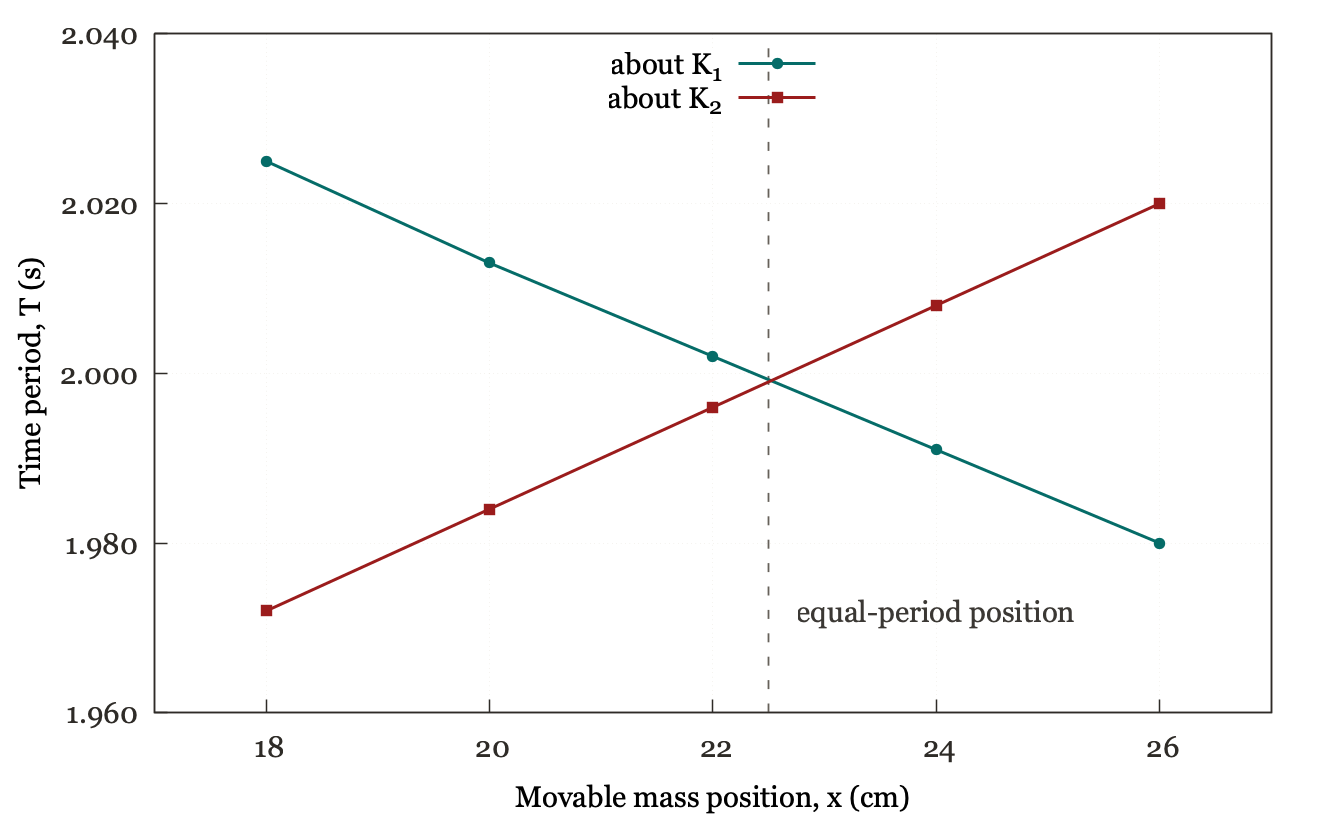
From the graph, the equal time period is approximately
\[T=2.000\text{ s}.\]Calculation
Using
\[g=\frac{4\pi^2L}{T^2},\]we get
\[g=\frac{4\pi^2(0.994)}{(2.000)^2}.\]Therefore,
\[g=9.81\text{ m s}^{-2}.\]Result
The acceleration due to gravity at the place of experiment is
\[\boxed{g=9.81\text{ m s}^{-2}}.\]Precautions
- The amplitude of oscillation should be small.
- The knife-edge should rest sharply and horizontally on the support.
- Count oscillations from the same extreme position each time.
- The movable mass should be fixed firmly after each adjustment.
- Avoid air currents near the pendulum.
Viva Questions
-
Why is Kater’s pendulum called reversible?
It can be suspended and oscillated from either of its two knife-edges. -
What is the advantage of Kater’s pendulum?
It avoids the need to locate the centre of gravity and centre of oscillation separately. -
Why should the amplitudes be small?
The formula for time period assumes small angular oscillations. -
What happens at the equal-period position?
The distance between the two knife-edges becomes the equivalent length of the simple pendulum. -
Why are many oscillations timed together?
Timing many oscillations reduces the percentage error in the measured time period.
Maxima Code
The calculation can be checked with this file: kater-pendulum-calculation.mac.


Discussion