

14 Jul 2026
Modulus of Rigidity by Maxwell's Needle
Aim
To determine the modulus of rigidity of the material of a suspension wire by Maxwell’s needle method.
Apparatus
Maxwell’s needle, suspension wire, stop watch, screw gauge, metre scale, and interchangeable hollow and solid cylinders.
Figure
Principle
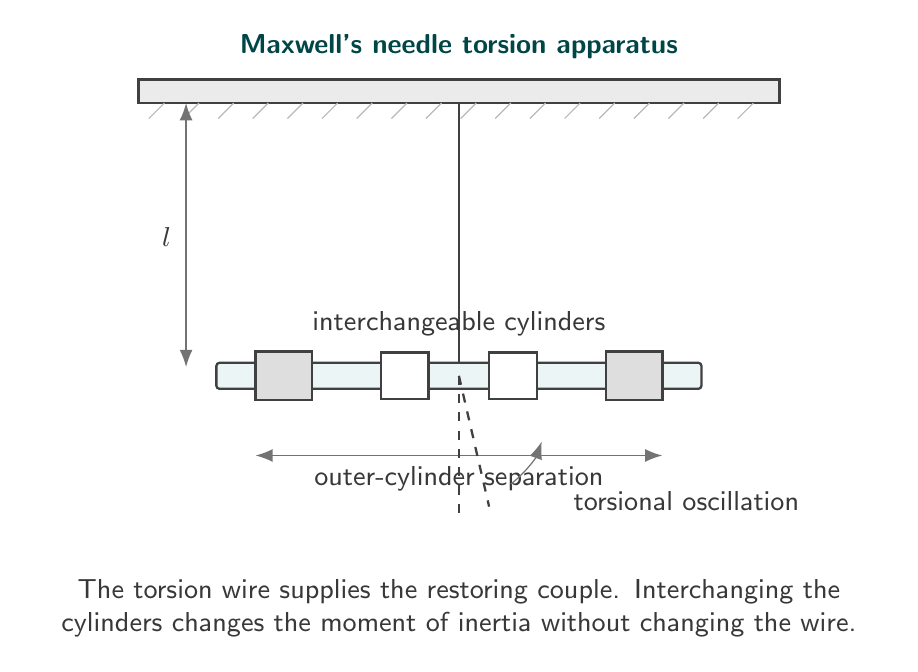
When a wire is twisted through a small angle, it provides a restoring couple. The suspended needle executes torsional oscillations. The time period is
\[T=2\pi\sqrt{\frac{I}{C}},\]where $I$ is the moment of inertia of the suspended system and $C$ is the torsional couple per unit twist. For a wire of length $l$ and radius $r$,
\[C=\frac{\pi \eta r^4}{2l},\]where $\eta$ is the modulus of rigidity.
By interchanging the hollow and solid cylinders, the change in moment of inertia is $\Delta I$. If the corresponding time periods are $T_1$ and $T_2$, then
\[\eta=\frac{8\pi l\Delta I}{r^4(T_1^2-T_2^2)}.\]Observations
Length of suspension wire:
\[l=60.0\text{ cm}=0.600\text{ m}.\]Radius of suspension wire:
\[r=0.25\text{ mm}=2.5\times10^{-4}\text{ m}.\]Change in moment of inertia after interchange:
\[\Delta I=2.98\times10^{-4}\text{ kg m}^2.\]| Trial | Time for 10 oscillations, outer heavy cylinders (s) | $T_1$ (s) | Time for 10 oscillations, inner heavy cylinders (s) | $T_2$ (s) |
|---|---|---|---|---|
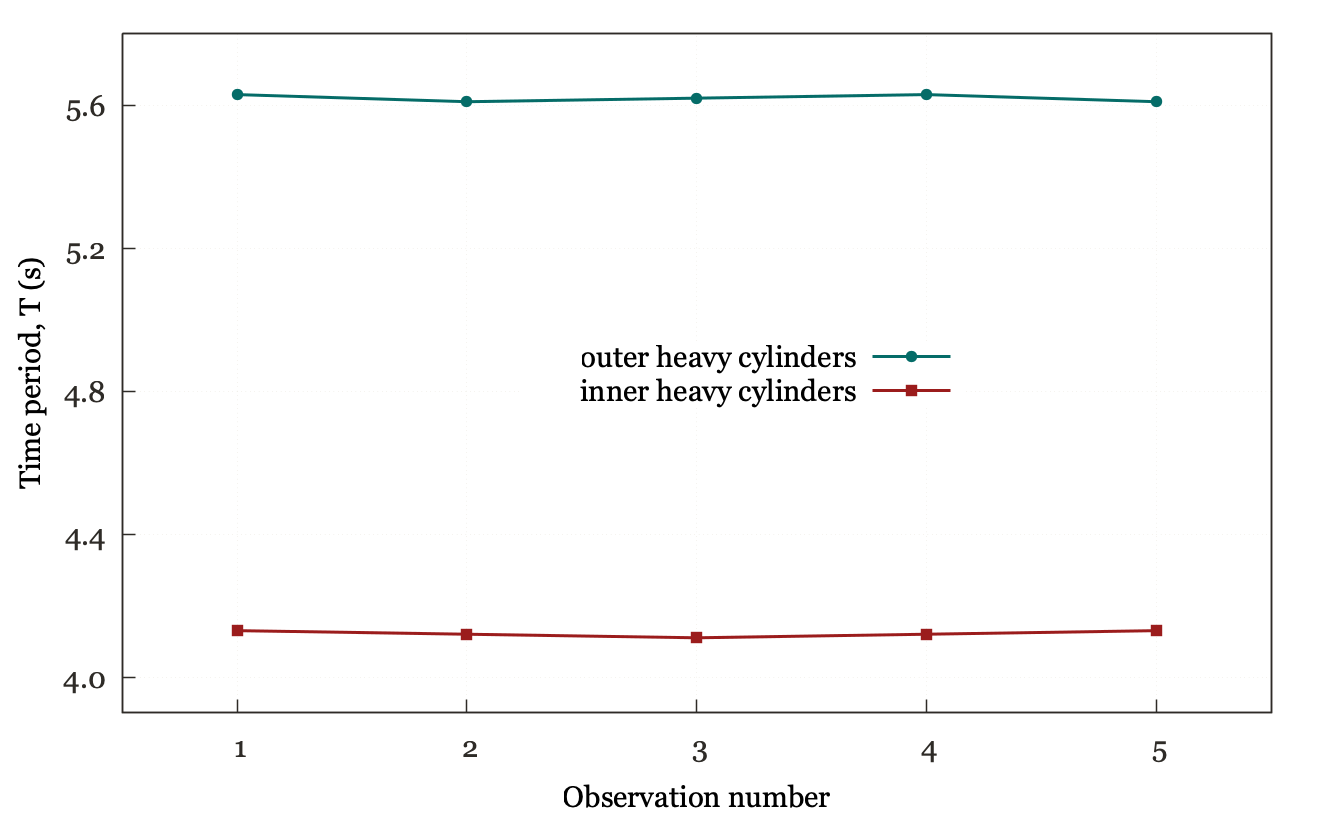
| 1 | 56.3 | 5.63 | 41.3 | 4.13 |
| 2 | 56.1 | 5.61 | 41.2 | 4.12 |
| 3 | 56.2 | 5.62 | 41.1 | 4.11 |
| 4 | 56.3 | 5.63 | 41.2 | 4.12 |
| 5 | 56.1 | 5.61 | 41.3 | 4.13 |
Mean values:
\[T_1=5.62\text{ s},\qquad T_2=4.12\text{ s}.\]Graph
Calculation
Using
\[\eta=\frac{8\pi l\Delta I}{r^4(T_1^2-T_2^2)},\]we get
\[\eta=\frac{8\pi(0.600)(2.98\times10^{-4})}{(2.5\times10^{-4})^4[(5.62)^2-(4.12)^2]}.\]Therefore,
\[\eta=7.91\times10^{10}\text{ N m}^{-2}.\]Result
The modulus of rigidity of the material of the wire is
\[\boxed{\eta=7.91\times10^{10}\text{ N m}^{-2}}.\]Precautions
- The wire should be thin, uniform, and free from kinks.
- The oscillations should be small and purely torsional.
- The cylinders must be fixed symmetrically on the needle.
- Avoid jerks while setting the needle into oscillation.
- Measure the wire radius carefully because the formula contains $r^4$.
Viva Questions
-
What is modulus of rigidity?
It is the ratio of shearing stress to shearing strain within the elastic limit. -
Why is the radius of the wire important?
The formula contains $r^4$, so a small error in radius produces a large error in the result. -
What type of oscillation is used in this experiment?
Torsional oscillation is used. -
Why are the cylinders interchanged?
Interchanging the cylinders changes the moment of inertia while keeping the same suspension wire. -
Why should the oscillations be small?
Small oscillations keep the restoring couple proportional to the angle of twist.
Maxima Code
The calculation can be checked with this file: maxwells-needle-calculation.mac.


Discussion