

14 Jul 2026
Young's Modulus by Searle's Method
Aim
To determine Young’s modulus of the material of a wire by Searle’s method.
Apparatus
Searle’s apparatus, two long wires of the same material, slotted weights, screw gauge, metre scale, spirit level, and micrometer screw.
Figure
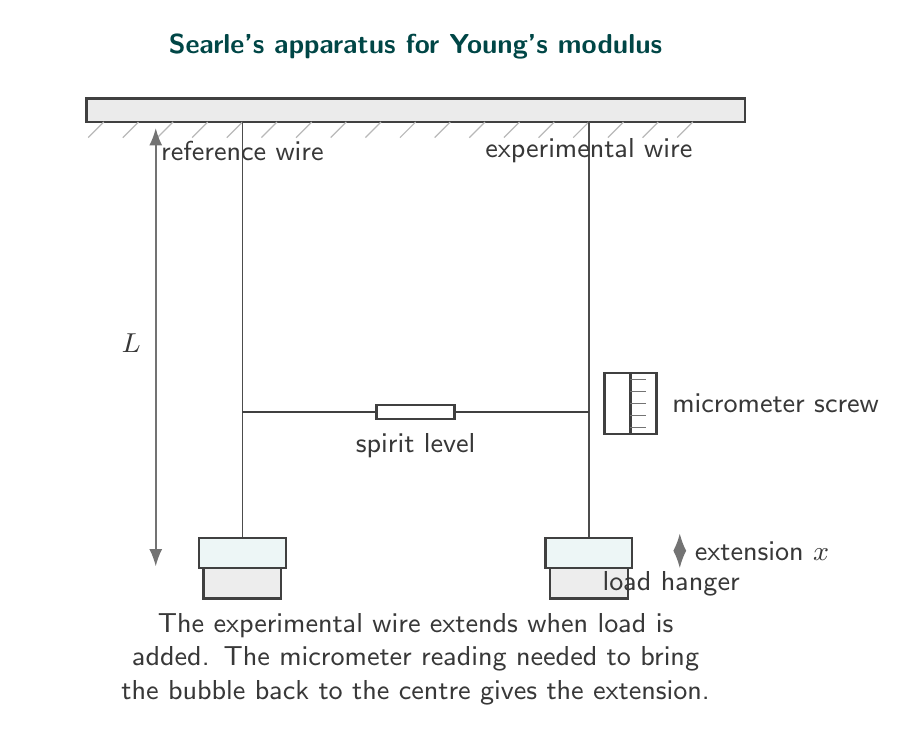
Principle
When a wire of length $L$ and radius $r$ is stretched by a load $Mg$, it extends by $x$. Young’s modulus is defined as
\[Y=\frac{\text{longitudinal stress}}{\text{longitudinal strain}}.\]For the wire,
\[Y=\frac{Mg/A}{x/L}=\frac{MgL}{\pi r^2 x}.\]If a graph is drawn between load $M$ and extension $x$, the slope gives $x/M$. Hence,
\[Y=\frac{gL}{\pi r^2 (x/M)}.\]Observations
Length of experimental wire:
\[L=1.50 \text{ m}.\]Diameter of wire:
| Trial | Diameter (mm) |
|---|---|
| 1 | 0.50 |
| 2 | 0.49 |
| 3 | 0.51 |
Mean diameter $d=0.50$ mm, so
\[r=0.25 \text{ mm}=2.5\times10^{-4}\text{ m}.\]Load-extension readings:
| Load, $M$ (kg) | Micrometer reading (mm) | Extension, $x$ (mm) |
|---|---|---|
| 0.5 | 1.19 | 0.19 |
| 1.0 | 1.38 | 0.38 |
| 1.5 | 1.56 | 0.56 |
| 2.0 | 1.76 | 0.76 |
| 2.5 | 1.94 | 0.94 |
| 3.0 | 2.14 | 1.14 |
Graph
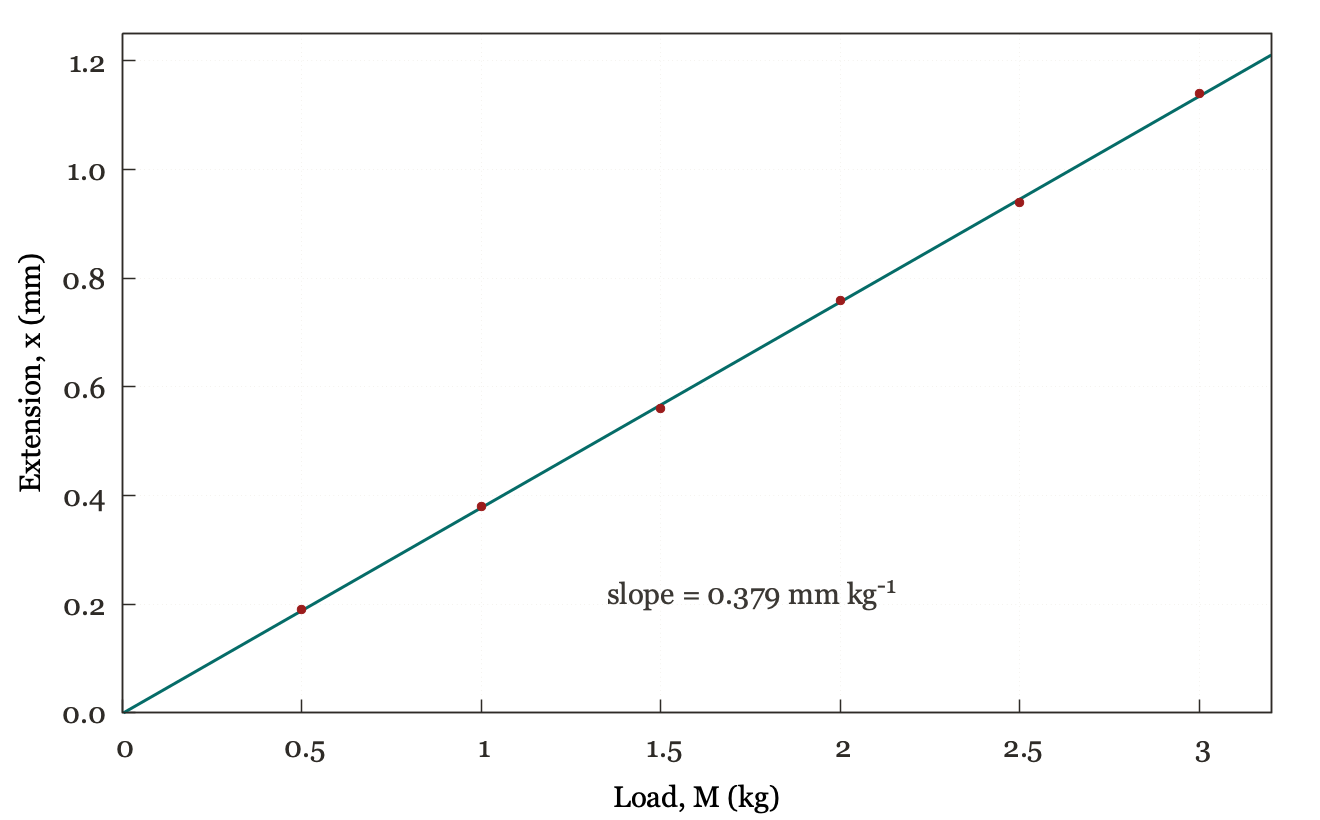
From the graph,
\[\frac{x}{M}=0.379\text{ mm kg}^{-1}=3.79\times10^{-4}\text{ m kg}^{-1}.\]Calculation
Using
\[Y=\frac{gL}{\pi r^2 (x/M)},\]we get
\[Y=\frac{9.81\times1.50}{\pi(2.5\times10^{-4})^2(3.79\times10^{-4})}.\]Therefore,
\[Y=1.98\times10^{11}\text{ N m}^{-2}.\]Result
Young’s modulus of the material of the wire is
\[\boxed{Y=1.98\times10^{11}\text{ N m}^{-2}}.\]Precautions
- The wire should be straight, vertical, and free from kinks.
- Add and remove loads gently.
- Bring the spirit level bubble to the centre before taking each reading.
- Do not exceed the elastic limit of the wire.
- Measure the diameter at several points and take the mean radius.
Viva Questions
-
What is Young’s modulus?
It is the ratio of longitudinal stress to longitudinal strain within the elastic limit. -
Why are two wires used in Searle’s apparatus?
One wire acts as a reference and helps remove errors due to support yielding and temperature change. -
Why is the diameter measured carefully?
The formula contains $r^2$, so a small error in radius produces a larger error in Young’s modulus. -
What is elastic limit?
It is the maximum stress up to which the body regains its original shape after the load is removed. -
Why should loading be gradual?
Sudden loading may produce jerks and non-uniform extension.
Maxima Code
The calculation can be checked with this file: searles-method-calculation.mac.


Discussion