

14 Jul 2026
Comparison of Capacitances by De Sauty's Bridge
Aim
To compare two capacitances using De Sauty’s bridge and determine the value of an unknown capacitance.
Apparatus
De Sauty’s bridge arrangement, two capacitors, resistance boxes, AC source, detector or headphone, key, and connecting wires.
Circuit Diagram
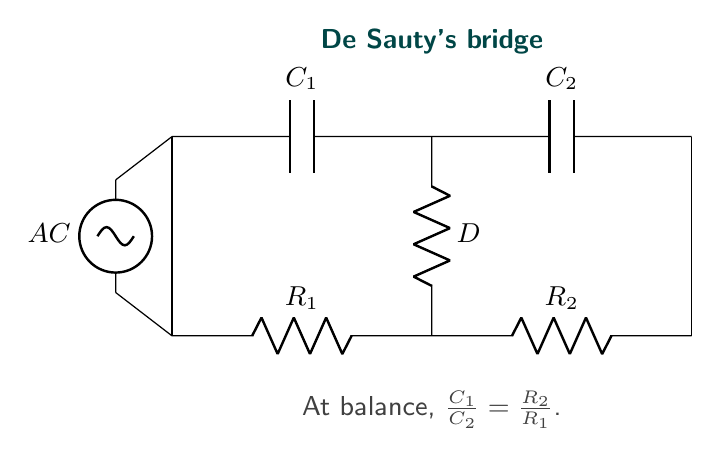
Theory
At balance, no current flows through the detector. For De Sauty’s bridge, the balance condition is
\[\frac{C_1}{C_2}=\frac{R_2}{R_1}.\]If $C_1$ is the unknown capacitance, then
\[C_1=C_2\frac{R_2}{R_1}.\]Observations
Known capacitance:
\[C_2=0.50\,\mu\text{F}.\]| Trial | $R_1$ ($\Omega$) | $R_2$ ($\Omega$) | $C_1=C_2R_2/R_1$ ($\mu$F) |
|---|---|---|---|
| 1 | 1200 | 1780 | 0.742 |
| 2 | 1200 | 1800 | 0.750 |
| 3 | 1200 | 1820 | 0.758 |
Mean value:
\[C_1=\frac{0.742+0.750+0.758}{3}=0.750\,\mu\text{F}.\]Result
The value of the unknown capacitance is
\[\boxed{C_1=0.750\,\mu\text{F}}.\]Precautions
- Use an AC source, not a DC source.
- Keep all connections tight and clean.
- Do not touch the circuit during balance adjustment.
- Use non-leaky capacitors for better balance.
- Take the balance point by minimum detector sound or zero detector deflection.
Viva Questions
-
Why is AC used in De Sauty’s bridge?
A capacitor does not pass steady DC, so an alternating source is required. -
What is the balance condition of De Sauty’s bridge?
The balance condition is $C_1/C_2=R_2/R_1$. -
Can this bridge compare leaky capacitors accurately?
No. Leakage resistance affects the balance and reduces accuracy. -
What is meant by null point?
It is the condition where the detector shows no signal. -
Why is a headphone sometimes used as detector?
It can detect small AC signals by sound.
Maxima Code
The calculation can be checked with this file: desauty-bridge-calculation.mac.


Discussion