

13 Jul 2026
Diffraction by Double Slits and Wavelength Determination
practical
ug-iii
optics
diffraction
double-slit
Aim
To study the diffraction pattern produced by two narrow slits and determine the wavelength of the source.
Apparatus
Laser or monochromatic source, double slit, optical bench, screen, metre scale, and slit holder.
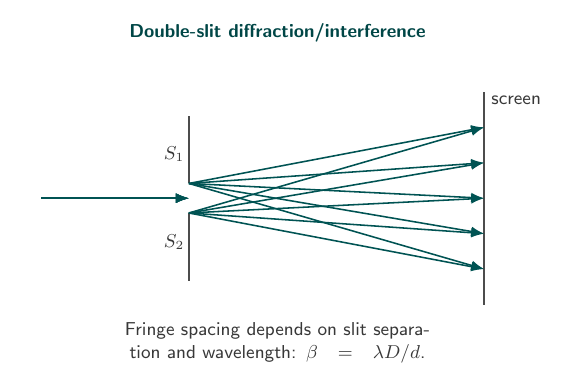
Schematic figure
Theory
The two slits act as coherent sources. For slit separation $d$ and screen distance $D$, the position of the $m$th bright fringe is approximately
\[x_m=\frac{m\lambda D}{d}.\]Thus, if $\Delta x$ is the distance across $2m$ fringe intervals,
\[\lambda=\frac{d\Delta x}{2mD}.\]Observations
Slit separation: $d=0.25\,\text{mm}$; screen distance: $D=2.00\,\text{m}$.
| Fringe order $m$ | Distance across $2m$ fringes $\Delta x$ (mm) | Wavelength (nm) |
|---|---|---|
| 5 | 23.52 | 588.0 |
| 6 | 28.25 | 588.5 |
| 7 | 32.90 | 587.5 |
Mean wavelength: $\lambda=588.0\,\text{nm}$.
Result
\[\boxed{\lambda=588\,\text{nm}}.\]Precautions
- The slits and screen should be parallel.
- Keep the source, slits, and screen at the same height.
- Measure a large number of fringes.
- Never look directly into a laser beam.
Viva Questions
- Why are interference fringes observed? The waves from the two coherent slits superpose.
- What determines fringe width? It depends on wavelength, screen distance, and slit separation.
- Why is a monochromatic source used? Different wavelengths would produce overlapping patterns.
- What is the central maximum? It is the bright maximum around the geometrical centre of the pattern.


Discussion