

13 Jul 2026
Wavelength of Sodium Light by Fresnel Biprism
practical
ug-iii
optics
interference
fresnel-biprism
Aim
To determine the wavelength of sodium light using interference fringes produced by a Fresnel biprism.
Apparatus
Fresnel biprism, sodium lamp, narrow slit, convex lens, eyepiece or micrometer microscope, and optical bench.
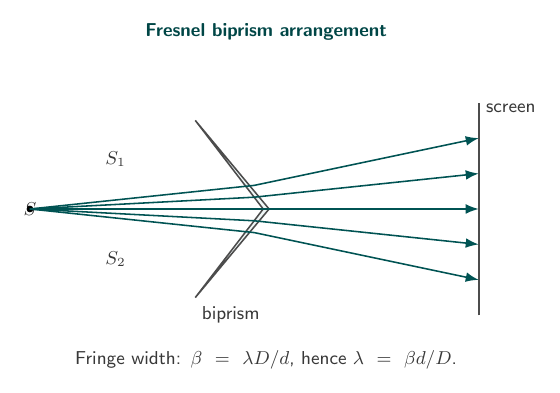
Schematic figure
Theory
The biprism produces two virtual coherent images $S_1$ and $S_2$ of the narrow slit. If their separation is $d$, the distance from the sources to the observation plane is $D$, and the fringe width is $\beta$,
\[\beta=\frac{\lambda D}{d},\qquad \lambda=\frac{\beta d}{D}.\]The separation $d$ is measured by the lens-displacement method.
Observations
Distance between virtual sources: $d=0.72\,\text{mm}$; source-to-screen distance: $D=1.20\,\text{m}$.
| Number of fringes | Width occupied (mm) | Fringe width $\beta$ (mm) |
|---|---|---|
| 20 | 19.63 | 0.9815 |
| 20 | 19.67 | 0.9835 |
| 20 | 19.65 | 0.9825 |
Mean $\beta=0.9825\,\text{mm}$.
Calculation
\[\lambda=\frac{0.9825\times0.72}{1200}\,\text{mm}=0.0005895\,\text{mm}=589.5\,\text{nm}.\]Result
The wavelength of sodium light is
\[\boxed{\lambda\approx589\,\text{nm}}.\]Precautions
- The slit should be narrow and vertical.
- Keep the biprism and slit at the same height.
- Measure fringe width over many fringes.
- Focus the microscope without disturbing the bench arrangement.
Viva Questions
- Why are the two sources coherent? They arise from the same original slit.
- Why is a narrow slit used? It gives two narrow virtual sources and sharp fringes.
- Why is a convex lens used? It magnifies and helps measure the separation of the virtual sources.
- What happens if the source separation increases? The fringe width decreases.


Discussion