

13 Jul 2026
Dispersive Power and Resolving Power of a Plane Grating
practical
ug-iii
optics
grating
resolving-power
Aim
To determine the dispersive power and resolving power of a plane diffraction grating.
Apparatus
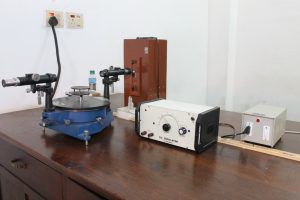
Spectrometer, plane grating, mercury vapour lamp, narrow slit, and reading lens.
Apparatus image
Theory
For a grating with element $d$, the angular dispersive power is
\[\frac{d\theta}{d\lambda}=\frac{n}{d\cos\theta}.\]The theoretical resolving power is
\[R=\frac{\lambda}{\Delta\lambda}=nN,\]where $N$ is the number of illuminated rulings. It is tested by observing whether two close spectral lines are separately visible.
Observations
Grating: $6000$ lines cm$^{-1}$; illuminated width: $2.0\,\text{cm}$; order: $n=2$.
| Line pair | $\theta_1$ | $\theta_2$ | Angular separation |
|---|---|---|---|
| Mercury yellow pair | $22^\circ10’$ | $22^\circ24’$ | $14’$ |
| Mercury green-violet pair | $20^\circ55’$ | $21^\circ09’$ | $14’$ |
Number of illuminated lines: $N=6000\times2=12000$.
Calculation
\[R=nN=2\times12000=24000.\]At $\theta=22^\circ$, the angular dispersive power is
\[\frac{d\theta}{d\lambda}=\frac{2}{(1/600000)\cos22^\circ}=2.16\times10^6\,\text{rad m}^{-1}.\]Result
\[\boxed{R=2.4\times10^4}.\]The observed spectral lines are resolved in the second order.
Precautions
- Use a narrow slit to obtain sharp spectral lines.
- Illuminate the grating uniformly.
- Compare lines at the same order.
- Take readings on both sides of the direct image.
Viva Questions
- What is resolving power? It is the ratio $\lambda/\Delta\lambda$ for two just-resolved wavelengths.
- How can resolving power be increased? By increasing the order or the number of illuminated grating lines.
- What is angular dispersive power? It is the angular separation produced per unit wavelength difference.
- Why does dispersion decrease at large angles? The factor $\cos\theta$ in the denominator changes the angular response.


Discussion