

13 Jul 2026
Radius of Curvature of a Plano-Convex Lens by Newton's Rings
practical
ug-iii
optics
interference
radius-of-curvature
Aim
To determine the radius of curvature of a plano-convex lens using Newton’s rings and sodium light of known wavelength.
Apparatus
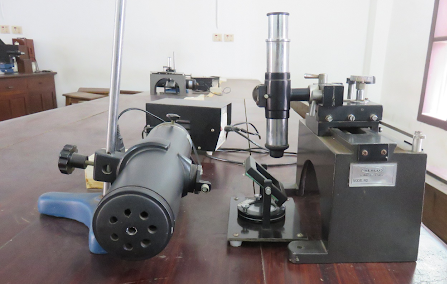
Newton’s-rings apparatus, plano-convex lens, travelling microscope, sodium vapour lamp, and glass plate.
Apparatus image
Theory
For the $n$th and $(n+p)$th dark rings,
\[D_{n+p}^2-D_n^2=4p\lambda R.\]Hence,
\[R=\frac{D_{n+p}^2-D_n^2}{4p\lambda}.\]Observations
Known wavelength: $\lambda=589.3\,\text{nm}$.
| Ring number | Diameter $D$ (mm) | $D^2$ (mm$^2$) |
|---|---|---|
| 10 | 2.04 | 4.16 |
| 20 | 3.20 | 10.24 |
| 30 | 4.56 | 20.79 |
| 40 | 6.00 | 36.00 |
Calculation
Using rings 10 and 20,
\[R=\frac{10.24-4.16}{4\times10\times0.0005893}\,\text{mm}=257.4\,\text{mm}.\]The mean of the values obtained from successive ring intervals is $R=0.260\,\text{m}$.
Result
The radius of curvature of the plano-convex lens is
\[\boxed{R=0.260\,\text{m}}.\]Precautions
- Use a clean lens and a clean glass plate.
- Take readings on both sides of the microscope cross-wire.
- Use several pairs of rings and take the mean value.
- Avoid parallax while reading the microscope scale.
Viva Questions
- What is measured in this experiment? The diameter of dark Newton’s rings.
- Why is sodium light required? Its known wavelength permits calculation of $R$.
- Why is a plano-convex lens used? It produces a gradually varying air film of circular symmetry.
- What is the main source of error? Incorrect focusing or reading of the ring edge.


Discussion