

13 Jul 2026
Wavelength of Sodium Light by Newton's Rings
Aim
To determine the wavelength of sodium light by measuring the diameters of Newton’s rings.
Apparatus
Newton’s-rings apparatus, plano-convex lens, optically flat glass plate, sodium vapour lamp, travelling microscope, and glass plate inclined at $45^\circ$.
Apparatus image
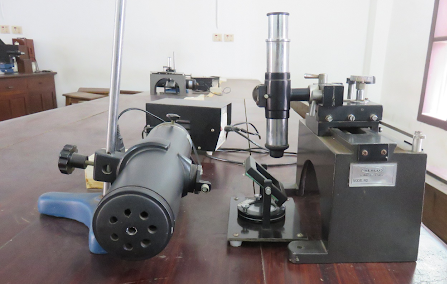
Principle
A plano-convex lens placed on a glass plate forms a thin air film whose thickness increases with distance from the point of contact. The two reflected rays interfere and produce concentric rings. For the $n$th dark ring,
\[D_n^2=4n\lambda R,\]where $R$ is the radius of curvature of the lens. Therefore,
\[\lambda=\frac{D_{n+p}^2-D_n^2}{4pR}.\]Observations
Radius of curvature of the lens: $R=1.00\,\text{m}$.
| Ring number $n$ | Left reading (mm) | Right reading (mm) | Diameter $D_n$ (mm) | $D_n^2$ (mm$^2$) |
|---|---|---|---|---|
| 10 | 12.14 | 14.18 | 2.04 | 4.16 |
| 20 | 10.12 | 15.39 | 5.27 | 27.77 |
| 30 | 9.64 | 16.81 | 7.17 | 51.41 |
| 40 | 8.98 | 17.63 | 8.65 | 74.82 |
Using a wider ring interval, $D_{20}^2-D_{10}^2=27.77-4.16=23.61\,\text{mm}^2$.
Calculation
With $p=10$ and $R=1000\,\text{mm}$,
\[\lambda=\frac{23.61}{4\times10\times1000}\,\text{mm}=0.000590\,\text{mm}=590\,\text{nm}.\]The small difference from the accepted sodium wavelength is due to the sample reading uncertainty.
Result
The wavelength of sodium light is
\[\boxed{\lambda\approx589\,\text{nm}}.\]Precautions
- The lens and glass plate must be clean.
- Focus the microscope on the same ring edge while taking both readings.
- Measure several rings and use widely separated ring numbers.
- Do not press the lens against the plate.
Viva Questions
- Why are the rings circular? The film thickness depends only on the radial distance from the contact point.
- Why is the central spot dark in reflected light? One reflected ray suffers a phase reversal, giving destructive interference at contact.
- Why are diameters squared? The theory gives $D_n^2$ proportional to the ring number.
- Why are higher-order rings preferred? Their larger diameters reduce the relative reading error.


Discussion