

13 Jul 2026
Characteristics of a BJT in Common-Emitter Configuration
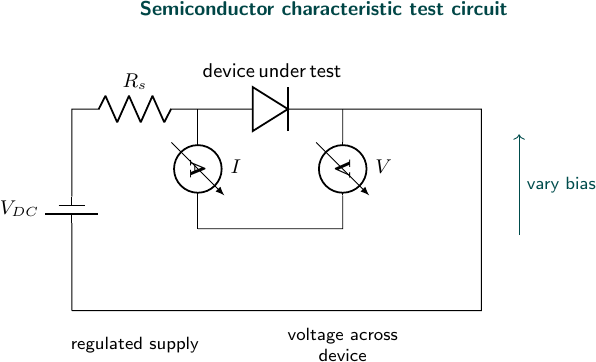
Experimental arrangement
Aim
To study the input and output characteristics of an NPN transistor in common-emitter configuration and determine its current gain.
Apparatus
NPN transistor, two DC supplies, microammeter, milliammeter, voltmeters, resistors, and connecting wires.
Theory
In common-emitter configuration the emitter is common to the input and output circuits. The input characteristic is the relation between $I_B$ and $V_{BE}$ at constant $V_{CE}$. The output characteristic is the relation between $I_C$ and $V_{CE}$ at constant $I_B$. In the active region,
\[\beta=\frac{\Delta I_C}{\Delta I_B}.\]Observations
For $V_{CE}=5\,\text{V}$:
| $V_{BE}$ (V) | $I_B$ ($\mu$A) |
|---|---|
| 0.55 | 2 |
| 0.60 | 8 |
| 0.65 | 22 |
| 0.68 | 40 |
| 0.70 | 62 |
For $I_B=40\,\mu$A:
| $V_{CE}$ (V) | $I_C$ (mA) |
|---|---|
| 0.2 | 0.20 |
| 1 | 3.6 |
| 3 | 4.0 |
| 5 | 4.1 |
| 8 | 4.2 |
Calculation
Using the active-region readings, $I_C$ changes from $3.6$ to $4.1\,\text{mA}$ when $I_B$ changes from $30$ to $40\,\mu$A. Hence,
\[\beta=\frac{4.1-3.6}{(40-30)\times10^{-3}}=50.\]Result
The transistor operates in cutoff, active, and saturation regions, and its current gain from the sample readings is
\[\boxed{\beta\approx50}.\]Precautions
- Do not exceed the transistor’s collector-current rating.
- Keep the emitter common throughout the experiment.
- Take output readings only after the meters become steady.
- Use separate scales for microampere and milliampere currents.
Viva Questions
- Why is the emitter called common? It is common to both input and output circuits.
- What is the active region? The emitter-base junction is forward biased and collector-base junction reverse biased.
- What is current gain? It is the ratio of change in collector current to change in base current.
- Why does collector current become nearly constant? In the active region it is controlled mainly by base current.


Discussion