

13 Jul 2026
Verification of Thevenin, Norton, Superposition and Maximum Power Transfer Theorems
Experimental arrangement
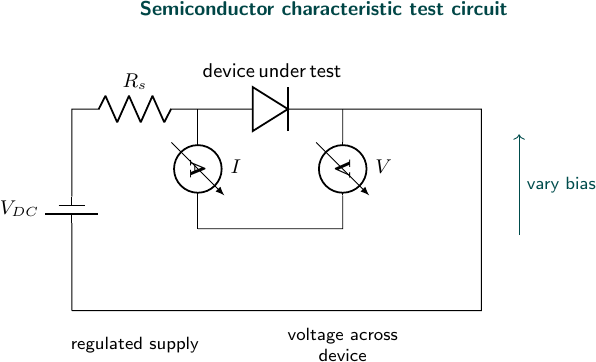
Aim
To verify Thevenin’s theorem, Norton’s theorem, the superposition theorem, and the maximum power transfer theorem for a DC resistive network.
Apparatus
DC power supplies, resistors, rheostat, voltmeter, ammeter, resistance box, key, and connecting wires.
Theory
Thevenin’s theorem replaces a linear two-terminal network by an equivalent voltage source $V_{th}$ in series with $R_{th}$. Norton’s theorem replaces it by a current source $I_N$ in parallel with $R_N$, where $R_N=R_{th}$. In the superposition theorem, the response in a linear network is the algebraic sum of responses produced by individual sources acting separately. Maximum power is delivered to the load when
\[R_L=R_{th}.\]Observations
Thevenin and Norton check
| Quantity | Direct network | Equivalent network |
|---|---|---|
| Open-circuit voltage $V_{th}$ | $6.02\,\text{V}$ | $6.00\,\text{V}$ |
| Short-circuit current $I_N$ | $12.0\,\text{mA}$ | $12.1\,\text{mA}$ |
| Equivalent resistance | $500\,\Omega$ | $495\,\Omega$ |
Superposition check
| Response | Measured current |
|---|---|
| Source $E_1$ alone | $4.0\,\text{mA}$ |
| Source $E_2$ alone | $2.0\,\text{mA}$ |
| Both sources together | $6.0\,\text{mA}$ |
Maximum power transfer
| $R_L$ ($\Omega$) | Load power (mW) |
|---|---|
| 250 | 16.0 |
| 400 | 18.4 |
| 500 | 18.0 |
| 600 | 17.1 |
| 1000 | 12.0 |
Result
The measured equivalent voltage, equivalent resistance, and source superposition agree with the corresponding theoretical values within experimental error. Maximum load power occurs close to $R_L=R_{th}$.
Precautions
- Switch off the supply while changing the circuit.
- Check meter polarity and range before taking readings.
- Replace an ideal voltage source by a short circuit only when finding equivalent resistance.
- Use a low resistance range for continuity checks and never short a powered supply.
Viva Questions
- When is Thevenin’s theorem applicable? To linear two-terminal networks.
- What is the relation between Norton and Thevenin resistance? $R_N=R_{th}$.
- How is an inactive voltage source replaced? By a short circuit.
- When is maximum power transferred? When the load resistance equals the Thevenin resistance.
- Why is superposition not applied directly to power? Power is proportional to the square of current or voltage and is therefore not a linear quantity.


Discussion