

13 Jul 2026
Thermal Conductivity of a Bad Conductor by Lee and Charlton's Method
practical
ug-v
thermal-physics
bad-conductor
lee-charlton
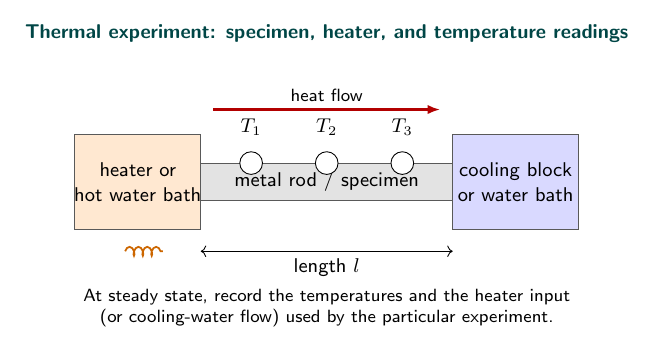
Experimental arrangement
Aim
To determine the thermal conductivity of a bad conductor by Lee and Charlton’s disc method.
Apparatus
Lee’s disc, steam chamber, bad-conductor specimen, thermometers, balance, stopwatch, and screw gauge.
Theory
The specimen is placed between the steam chamber and a brass disc. After the steady temperature $\theta$ is reached, the specimen is removed and the brass disc is allowed to cool through a small temperature range. If $m$, $s$, and $A$ are the mass, specific heat, and area of the disc, $d$ is specimen thickness, and $d\theta/dt$ is the cooling rate,
\[K=\frac{msd}{A(\theta_1-\theta_2)}\left|\frac{d\theta}{dt}\right|.\]Observations
Disc mass $m=0.420\,\text{kg}$, specific heat $s=380\,\text{J kg}^{-1}\text{K}^{-1}$, specimen thickness $d=0.004\,\text{m}$, area $A=0.00785\,\text{m}^2$.
| Temperature interval (°C) | Time (s) |
|---|---|
| 50 to 45 | 205 |
| 45 to 40 | 232 |
| 40 to 35 | 268 |
| Mean cooling rate near $45^\circ\text{C}$: $ | d\theta/dt | =5/232=0.02155\,\text{K s}^{-1}$. |
Calculation
\[K=\frac{0.420\times380\times0.004}{0.00785}\times0.02155 =1.74\,\text{W m}^{-1}\text{K}^{-1}.\]Result
\[\boxed{K=1.74\,\text{W m}^{-1}\text{K}^{-1}}.\]Precautions
- The specimen should completely cover the disc area.
- Use the cooling rate at the same temperature at which the steady state was observed.
- Avoid parallax while reading the thermometer.
- Keep the steam pressure nearly constant.
Viva Questions
- Why is the cooling curve used? It gives the rate at which the disc loses heat.
- Why is the specimen a bad conductor? A large temperature gradient can then be established across a small thickness.
- What is Newton’s law of cooling? The cooling rate is approximately proportional to the temperature excess for a small temperature range.
- Why should the specimen cover the disc? It ensures that the heat flow area is known and uniform.


Discussion