

13 Jul 2026
Temperature Coefficient of Resistance by Platinum Resistance Thermometer
practical
ug-v
thermal-physics
resistance-thermometer
platinum
Experimental arrangement
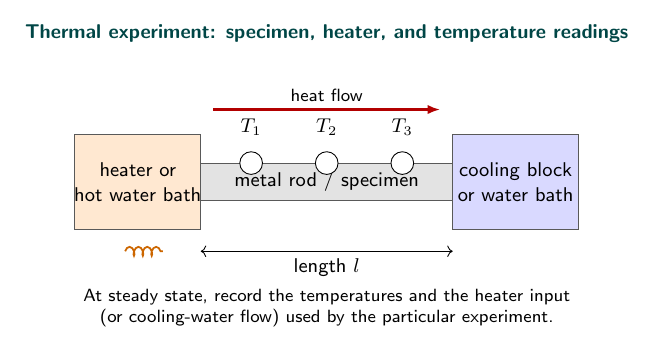
Aim
To determine the temperature coefficient of resistance of platinum using a platinum resistance thermometer.
Apparatus
Platinum resistance coil, bridge circuit, galvanometer, resistance box, thermometer, water bath, and heater.
Theory
For a moderate temperature range,
\[R_t=R_0(1+\alpha t),\]where $R_0$ is the resistance at $0^\circ\text{C}$ and $\alpha$ is the temperature coefficient. Thus,
\[\alpha=\frac{R_t-R_0}{R_0t}.\]Observations
Resistance at $0^\circ\text{C}$: $R_0=10.00\,\Omega$.
| Temperature (°C) | Resistance (Ω) | Calculated $\alpha$ (°C$^{-1}$) |
|---|---|---|
| 20 | 10.78 | 0.00390 |
| 40 | 11.57 | 0.00393 |
| 60 | 12.36 | 0.00393 |
| 80 | 13.14 | 0.00393 |
Result
The temperature coefficient of platinum resistance is
\[\boxed{\alpha=3.92\times10^{-3}\, ^\circ\text{C}^{-1}}.\]Precautions
- Stir the water bath to maintain uniform temperature.
- Wait for thermal equilibrium before measuring resistance.
- Use small bridge current to avoid self-heating.
- Record temperature and resistance simultaneously.
Viva Questions
- Why is platinum used? It is stable, reproducible, and has a nearly linear resistance-temperature relation.
- What is self-heating? It is the rise in thermometer temperature due to measuring current.
- Why is a water bath used? It gives a uniform and controllable temperature.
- How does resistance of platinum vary with temperature? It increases approximately linearly over a moderate range.


Discussion