

13 Jul 2026
Thermal Conductivity of Copper by Searle's Apparatus
practical
ug-v
thermal-physics
conductivity
searle
Experimental arrangement
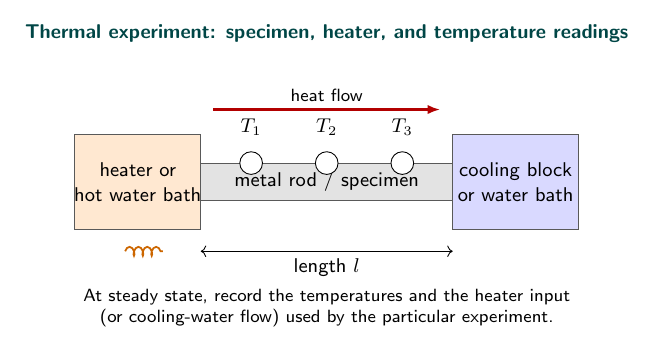
Aim
To determine the coefficient of thermal conductivity of copper using Searle’s apparatus.
Apparatus
Copper rod, steam chamber, cooling water jacket, thermometers, measuring cylinder, stopwatch, and balance.
Theory
In the steady state, heat conducted through the rod per second equals heat gained by the cooling water per second. If $A$ and $l$ are the rod area and length, $T_1-T_2$ is the temperature fall, and $m/t$ is the mass-flow rate of water,
\[K\frac{A(T_1-T_2)}{l}=\frac{m}{t}c_w(\theta_2-\theta_1).\]Therefore,
\[K=\frac{mlc_w(\theta_2-\theta_1)}{tA(T_1-T_2)}.\]Observations
Rod length $l=0.50\,\text{m}$, diameter $d=0.012\,\text{m}$, $A=1.131\times10^{-4}\,\text{m}^2$.
| Trial | Hot end $T_1$ (°C) | Cold end $T_2$ (°C) | Water rise (°C) | Water collected (kg) | Time (s) |
|---|---|---|---|---|---|
| 1 | 96.0 | 42.0 | 5.2 | 0.120 | 300 |
| 2 | 96.2 | 42.1 | 5.3 | 0.121 | 300 |
| 3 | 96.1 | 42.0 | 5.2 | 0.120 | 300 |
Calculation
Using $c_w=4200\,\text{J kg}^{-1}\text{K}^{-1}$,
\[K=\frac{0.120\times0.50\times4200\times5.2}{300\times1.131\times10^{-4}\times54}=0.637\,\text{W m}^{-1}\text{K}^{-1}.\]Result
The coefficient of thermal conductivity of the copper rod from the sample record is
\[\boxed{K=0.637\,\text{W m}^{-1}\text{K}^{-1}}.\]Precautions
- Take readings only after steady state is reached.
- Ensure good thermal contact between the rod and thermometers.
- Remove air bubbles from the cooling-water jacket.
- Measure the water mass and time accurately.
Viva Questions
- What is steady state? It is the condition in which the temperature at each point remains constant with time.
- Why is water circulated? It removes heat at a known rate and permits calorimetric measurement.
- Why is the rod insulated? To reduce heat loss from its lateral surface.
- What is the SI unit of $K$? Watt metre$^{-1}$ kelvin$^{-1}$.


Discussion