

13 Jul 2026
Specific Heat of a Liquid by the Method of Cooling
practical
ug-v
thermal-physics
specific-heat
cooling
Aim
To determine the specific heat of a liquid by comparing its rate of cooling with that of water.
Apparatus
Newton’s cooling apparatus, calorimeter, thermometer, balance, water, test liquid, and stopwatch.
Theory
For equal masses and nearly equal temperature excesses, the heat-loss rate is proportional to the product of mass and specific heat. If the cooling rates of water and the liquid are $r_w$ and $r_l$,
\[s_l=s_w\frac{r_l}{r_w}.\]The cooling curves are compared at the same temperature range so that the surrounding conditions are alike.
Observations
Cooling interval: $60^\circ\text{C}$ to $50^\circ\text{C}$; equal mass in each trial.
| Substance | Time for 10°C fall (s) | Cooling rate (°C s$^{-1}$) |
|---|---|---|
| Water | 480 | 0.02083 |
| Test liquid | 690 | 0.01449 |
Cooling graph
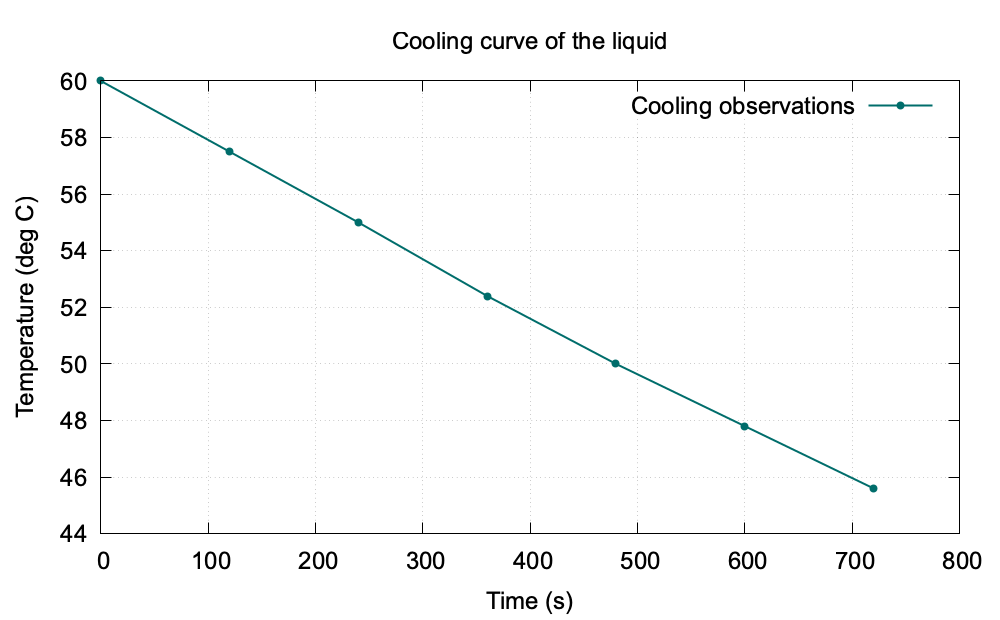
Taking $s_w=4200\,\text{J kg}^{-1}\text{K}^{-1}$,
Calculation
\[s_l=4200\times\frac{0.01449}{0.02083}=2922\,\text{J kg}^{-1}\text{K}^{-1}.\]Result
The specific heat of the test liquid is
\[\boxed{s_l=2.92\times10^3\,\text{J kg}^{-1}\text{K}^{-1}}.\]Precautions
- Use equal masses of water and liquid.
- Compare cooling rates at the same temperatures.
- Stir gently to maintain uniform temperature.
- Protect the calorimeter from draughts.
Viva Questions
- Why are equal temperature intervals used? The heat-loss conditions are then comparable.
- Why is the cooling curve not assumed perfectly linear? The rate changes as the temperature excess changes.
- Why is a lag correction sometimes needed? The thermometer and liquid may not have exactly the same temperature at each instant.
- What is specific heat? It is the heat required to raise the temperature of unit mass by one kelvin.


Discussion