

13 Jul 2026
Temperature Coefficient of Resistance of a Wire
practical
ug-v
thermal-physics
resistance
temperature-coefficient
Aim
To determine the temperature coefficient of resistance of the material of a wire.
Apparatus
Resistance wire, Wheatstone bridge, galvanometer, resistance box, water bath, thermometer, and battery.
Theory
For a conductor over a limited temperature interval,
\[R_t=R_0(1+\alpha t).\]The slope of the $R$ versus $t$ graph gives $R_0\alpha$.
Observations
| Temperature (°C) | Resistance (Ω) |
|---|---|
| 20 | 5.42 |
| 40 | 5.84 |
| 60 | 6.25 |
| 80 | 6.67 |
Graph
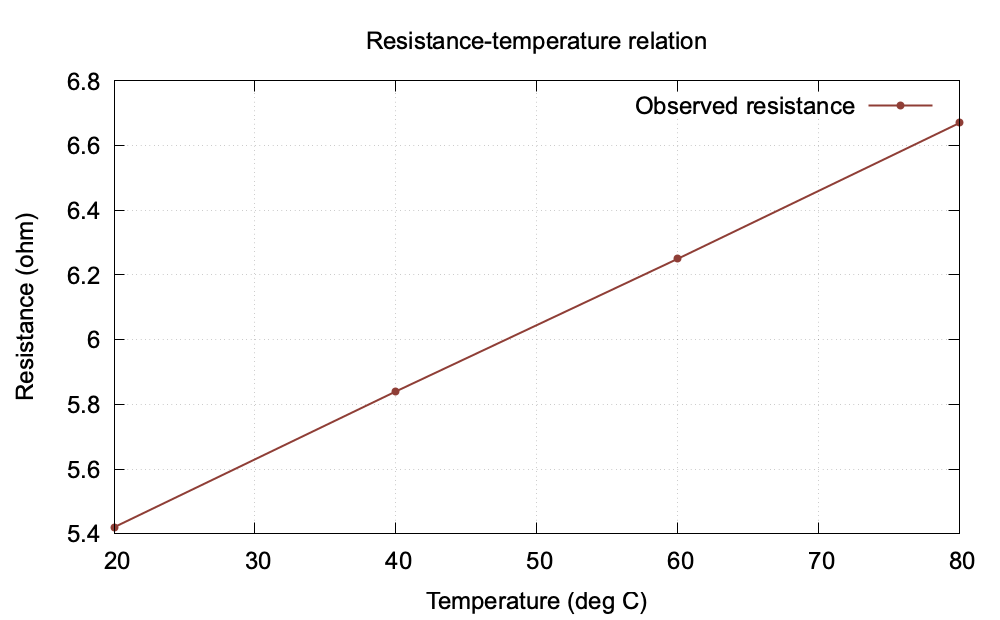
Extrapolated resistance at $0^\circ\text{C}$: $R_0=5.00\,\Omega$.
Calculation
Using the $20^\circ\text{C}$ reading,
\[\alpha=\frac{5.42-5.00}{5.00\times20}=4.20\times10^{-3}\, ^\circ\text{C}^{-1}.\]Result
\[\boxed{\alpha=4.2\times10^{-3}\, ^\circ\text{C}^{-1}}.\]Precautions
- Maintain uniform bath temperature.
- Use a small bridge current.
- Avoid loose electrical contacts.
- Take readings only after thermal equilibrium.
Viva Questions
- Why does metallic resistance increase with temperature? Lattice vibrations increase scattering of conduction electrons.
- Why is a bridge used? It permits accurate comparison of small resistance changes.
- What is $R_0$? Resistance extrapolated to zero degree Celsius.


Discussion