

13 Jul 2026
Thermo-Emf of a Thermocouple for a Temperature Difference
practical
ug-v
thermal-physics
thermocouple
thermo-emf
Experimental arrangement
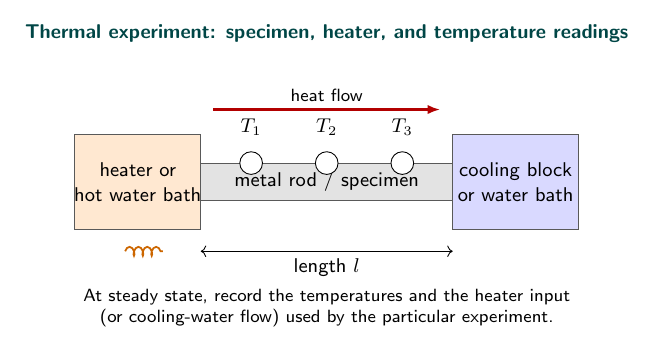
Aim
To study the variation of thermo-emf of a thermocouple with the temperature difference between its junctions.
Apparatus
Copper-constantan thermocouple, galvanometer or millivoltmeter, hot-water bath, cold-water bath, thermometer, and connecting wires.
Theory
When the two junctions of dissimilar metals are at different temperatures, a thermo-emf is produced. For a limited range,
\[E=a\Delta T+b(\Delta T)^2.\]The emf is zero when both junctions are at the same temperature. The neutral temperature is the temperature at which the thermo-emf is maximum.
Observations
Cold junction temperature: $20^\circ\text{C}$.
| Hot junction (°C) | $\Delta T$ (°C) | Thermo-emf (mV) |
|---|---|---|
| 30 | 10 | 0.22 |
| 40 | 20 | 0.43 |
| 50 | 30 | 0.63 |
| 60 | 40 | 0.81 |
| 70 | 50 | 0.96 |
Result
The thermo-emf increases with the temperature difference over the observed range. The mean sensitivity from the end readings is
\[\boxed{\frac{E}{\Delta T}=0.0192\,\text{mV K}^{-1}}.\]Precautions
- Keep the cold junction at a fixed temperature.
- Avoid direct contact between the two baths.
- Use a sensitive millivoltmeter without disturbing the junctions.
- Wait for thermal equilibrium at each temperature.
Viva Questions
- What is the Seebeck effect? It is the production of emf in a circuit of dissimilar metals when its junctions are at different temperatures.
- What is a reference junction? It is the junction maintained at a known temperature.
- Why is the emf small? Thermoelectric voltage per kelvin is small for ordinary metal pairs.
- What is neutral temperature? It is the hot-junction temperature at which thermo-emf becomes maximum for a fixed cold junction.


Discussion