

13 Jul 2026
B-H Curve and Hysteresis Energy Loss of Iron
practical
ug-vi
magnetism
hysteresis
bh-curve
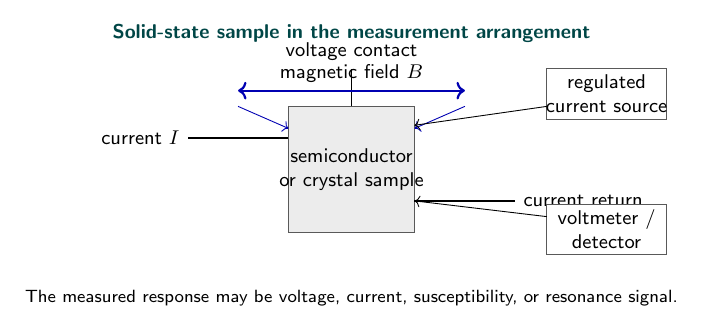
Experimental arrangement
Aim
To plot the B-H curve of an iron sample and determine its hysteresis energy loss.
Apparatus
Iron ring or transformer core, primary and secondary coils, CRO, integrator circuits, AC supply, and voltmeter.
Theory
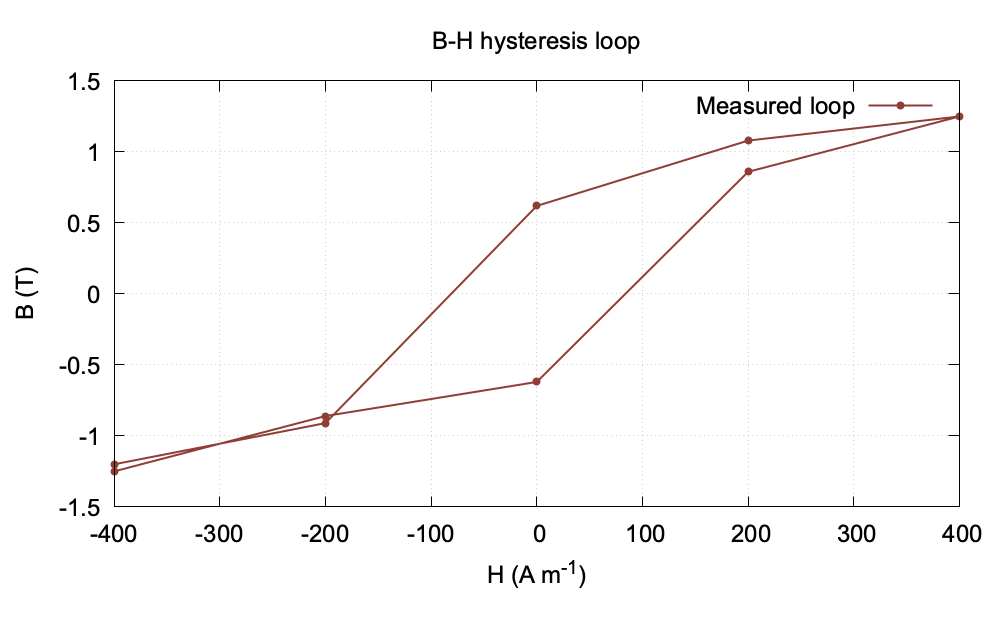
The magnetising field is proportional to the primary current and the magnetic induction is obtained from the integrated secondary voltage. The area of the B-H loop represents energy loss per unit volume per cycle.
Observations
| $H$ (A m$^{-1}$) | $B$ (T) on increasing field | $B$ (T) on decreasing field |
|---|---|---|
| 0 | 0.00 | 0.62 |
| 100 | 0.48 | 0.73 |
| 200 | 0.86 | 0.91 |
| 300 | 1.10 | 1.08 |
| 400 | 1.25 | 1.20 |
Retentivity: $B_r=0.62\,\text{T}$; coercivity: $H_c=95\,\text{A m}^{-1}$.
Graph
Result
The iron sample shows a closed hysteresis loop with
\[\boxed{B_r=0.62\,\text{T}},\qquad \boxed{H_c=95\,\text{A m}^{-1}}.\]The loop area gives the hysteresis energy loss per unit volume per cycle.
Precautions
- Demagnetise the core before beginning.
- Avoid saturation of the CRO input.
- Use a calibrated integrator.
- Keep the frequency constant while comparing losses.
Viva Questions
- What is retentivity? It is the residual magnetisation when the applied field is reduced to zero.
- What is coercivity? It is the reverse field required to reduce the residual induction to zero.
- What does the loop area represent? Energy dissipated per unit volume per cycle.


Discussion