

13 Jul 2026
Hall Coefficient of a Semiconductor Sample
practical
ug-vi
semiconductor
hall-effect
hall-coefficient
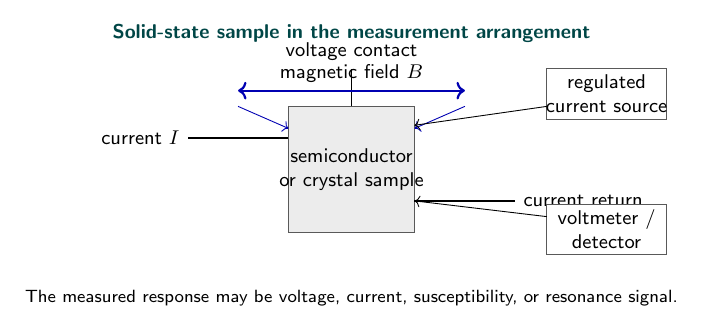
Experimental arrangement
Aim
To determine the Hall coefficient and carrier concentration of a semiconductor sample.
Apparatus
Semiconductor Hall sample, electromagnet, constant-current source, microvoltmeter, Gauss meter, and micrometer.
Theory
When current flows through a semiconductor in a perpendicular magnetic field, a transverse Hall voltage is produced. For sample thickness $t$,
\[R_H=\frac{V_Ht}{IB},\qquad n=\frac{1}{eR_H}.\]The sign of $V_H$ identifies the dominant carrier type.
Observations
Sample thickness $t=0.50\,\text{mm}$; current $I=5\,\text{mA}$.
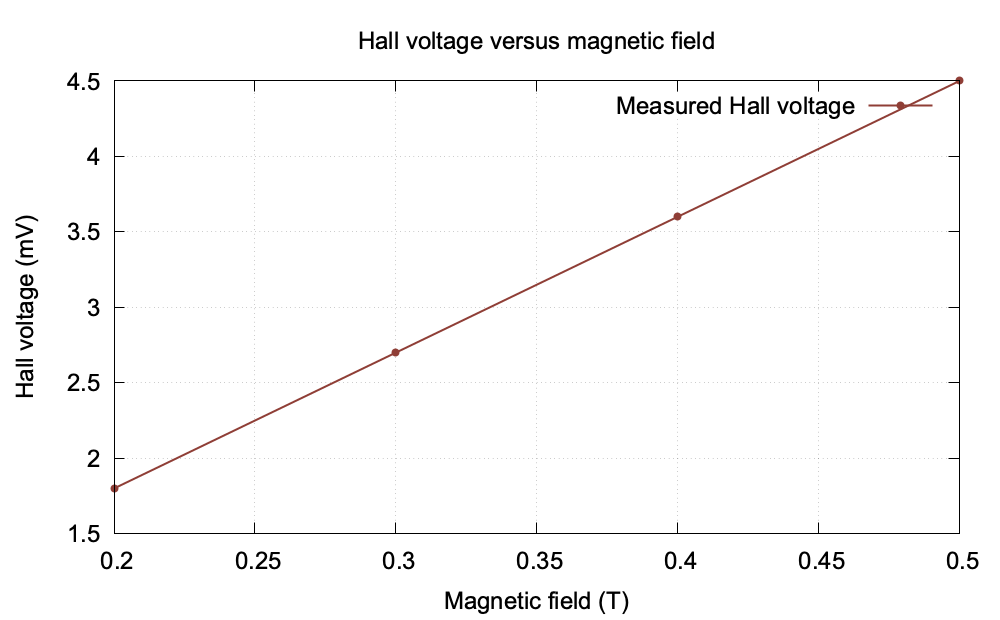
| Magnetic field (T) | Hall voltage (mV) |
|---|---|
| 0.20 | 1.8 |
| 0.30 | 2.7 |
| 0.40 | 3.6 |
| 0.50 | 4.5 |
Graph
Calculation
For $B=0.40\,\text{T}$ and $V_H=3.6\,\text{mV}$,
\[R_H=\frac{3.6\times10^{-3}\times0.50\times10^{-3}}{5\times10^{-3}\times0.40}=2.25\times10^{-3}\,\text{m}^3\text{C}^{-1}.\]Thus $n=1/(eR_H)=2.78\times10^{21}\,\text{m}^{-3}$.
Result
\[\boxed{R_H=2.25\times10^{-3}\,\text{m}^3\text{C}^{-1}},\qquad \boxed{n=2.78\times10^{21}\,\text{m}^{-3}}.\]Precautions
- Reverse the magnetic field and average the Hall readings.
- Keep the sample current constant.
- Ensure that the magnetic field is perpendicular to the current.
Viva Questions
- What is the Hall effect? It is the production of a transverse voltage in a current-carrying sample placed in a magnetic field.
- What determines the sign of Hall voltage? The sign of the dominant charge carriers.
- Why is a thin sample preferred? It gives a measurable Hall voltage for a given current and field.


Discussion