

13 Jul 2026
Magnetic Susceptibility of Solid Samples
practical
ug-vi
magnetism
susceptibility
solids
Experimental arrangement
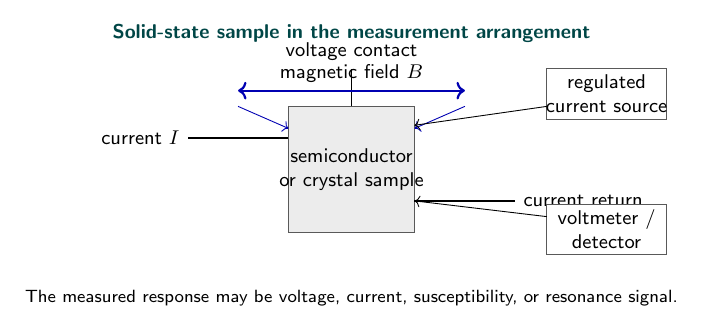
Aim
To determine and compare the magnetic susceptibility of solid samples by a force or Gouy-balance method.
Apparatus
Gouy balance, electromagnet, sample tube, analytical balance, power supply, and Gauss meter.
Theory
The force on a sample in a non-uniform field is related to its susceptibility. In the calibrated form of the apparatus,
\[\chi=C\frac{\Delta m}{H^2},\]where $C$ is the apparatus constant, $\Delta m$ is the change in apparent mass, and $H$ is the field.
Observations
| Sample | $H$ (A m$^{-1}$) | Apparent mass change (mg) | Susceptibility |
|---|---|---|---|
| Alum | $2.10\times10^5$ | 7.2 | $1.7\times10^{-5}$ |
| Ferric salt | $2.10\times10^5$ | 128.0 | $3.0\times10^{-4}$ |
| Bismuth | $2.10\times10^5$ | -4.1 | $-9.7\times10^{-6}$ |
Result
The ferric salt is strongly paramagnetic, alum is weakly paramagnetic, and bismuth is diamagnetic.
Precautions
- Remove magnetic materials from the balance platform.
- Keep the sample position fixed.
- Record the field after it becomes steady.
- Use an empty-tube correction.
Viva Questions
- What is a diamagnetic substance? It is weakly repelled by a magnetic field and has negative susceptibility.
- Why is a calibration constant used? The measured balance change is converted into susceptibility through calibration.
- Why should the sample be dry? Moisture changes the mass and may contribute its own magnetic response.


Discussion