

13 Jul 2026
Coupling Coefficient of a Piezoelectric Crystal
practical
ug-vi
piezoelectricity
crystal
coupling
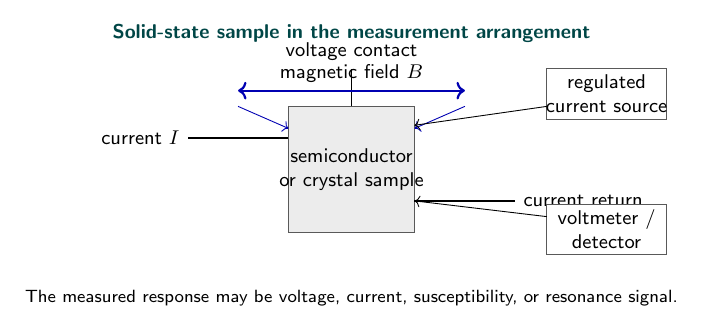
Experimental arrangement
Aim
To determine the electromechanical coupling coefficient of a piezoelectric crystal from its resonance and anti-resonance frequencies.
Apparatus
Piezoelectric crystal, oscillator, frequency meter, electrodes, and CRO.
Theory
The coupling coefficient measures conversion between electrical and mechanical energy. If $f_r$ and $f_a$ are the resonance and anti-resonance frequencies,
\[k^2=\frac{\pi^2}{8}\frac{f_a-f_r}{f_r}\]for the standard small-coupling approximation used in the experiment.
Observations
| Trial | Resonance $f_r$ (kHz) | Anti-resonance $f_a$ (kHz) |
|---|---|---|
| 1 | 31.20 | 32.05 |
| 2 | 31.18 | 32.04 |
| 3 | 31.21 | 32.06 |
Calculation
Using $f_r=31.20\,\text{kHz}$ and $f_a=32.05\,\text{kHz}$,
\[k=\sqrt{\frac{\pi^2}{8}\frac{32.05-31.20}{31.20}}=0.183.\]Result
\[\boxed{k=0.183}.\]Precautions
- Keep the crystal firmly mounted but free from mechanical stress.
- Sweep frequency slowly near resonance.
- Avoid excessive drive voltage.
Viva Questions
- What is piezoelectricity? It is the coupling between mechanical strain and electric polarisation in certain crystals.
- What is resonance? It is the condition of maximum response at a natural frequency.
- Why is anti-resonance observed? Electrical and mechanical responses combine to give a minimum current at a nearby frequency.


Discussion