

13 Jul 2026
Magnetic Susceptibility of a Paramagnetic Solution by Quincke's Method
practical
ug-vi
magnetism
susceptibility
quincke
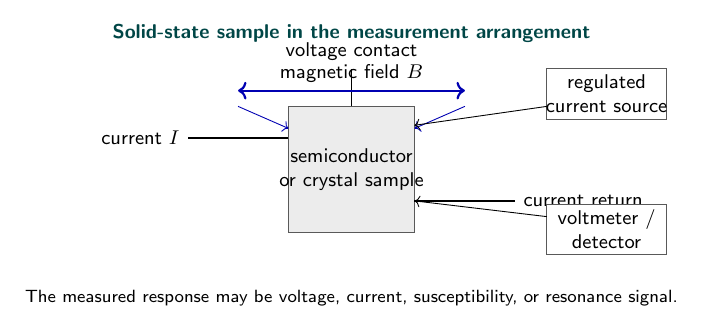
Experimental arrangement
Aim
To determine the magnetic susceptibility of a paramagnetic solution using Quincke’s tube method.
Apparatus
Quincke’s tube, electromagnet, travelling microscope, measuring cylinder, paramagnetic solution, and Gauss meter.
Theory
When a paramagnetic liquid is placed in a non-uniform magnetic field, its level rises in the field region. If $h$ is the rise, $H$ is the magnetic field, and $\rho$ is the density,
\[\chi=\frac{2\rho gh}{\mu_0H^2}.\]The height difference is measured with the microscope for different values of current.
Observations
| Current (A) | Field $H$ (A m$^{-1}$) | Rise $h$ (mm) |
|---|---|---|
| 1.0 | $1.20\times10^4$ | 1.2 |
| 1.5 | $1.80\times10^4$ | 2.7 |
| 2.0 | $2.40\times10^4$ | 4.8 |
| 2.5 | $3.00\times10^4$ | 7.4 |
For the solution, $\rho=1050\,\text{kg m}^{-3}$.
Result
Substitution of the mean $h/H^2$ value gives
\[\boxed{\chi=3.1\times10^{-4}}.\]Precautions
- Remove air bubbles from the tube.
- Set the tube symmetrically between the pole pieces.
- Take microscope readings without parallax.
- Do not change the liquid column after filling the tube.
Viva Questions
- Why does a paramagnetic liquid rise? It is attracted towards the region of stronger magnetic field.
- What is susceptibility? It is the ratio of intensity of magnetisation to applied magnetic field.
- Why is a non-uniform field required? A force acts on the liquid only when the field has a gradient.


Discussion