

13 Jul 2026
Energy Gap of a Semiconductor Using a PN Junction
practical
ug-vi
solid-state
semiconductor
energy-gap
Experimental arrangement
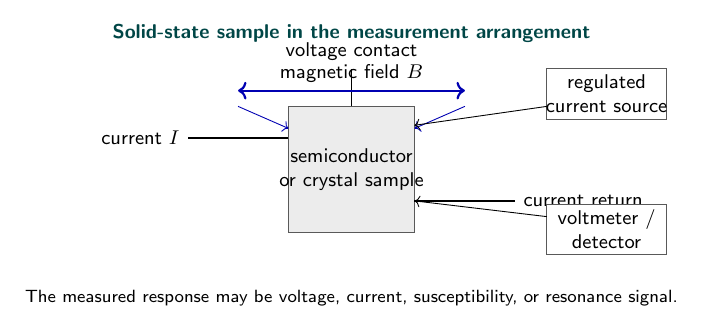
Aim
To determine the energy gap of a semiconductor from the variation of reverse saturation current with temperature.
Apparatus
PN junction diode, heating arrangement, thermometer, regulated supply, microammeter, and voltmeter.
Theory
The reverse saturation current varies approximately as
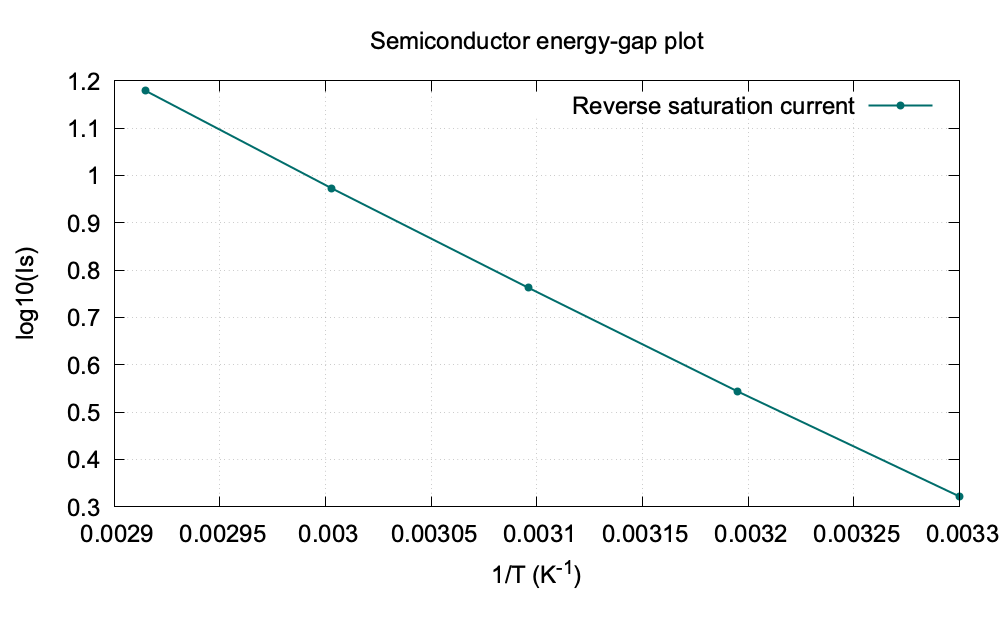
\[I_s=I_0e^{-E_g/(kT)}.\]Therefore, a plot of $\log_{10}I_s$ against $1/T$ is a straight line with slope $-E_g/(2.303k)$.
Observations
| Temperature (K) | Reverse current ($\mu$A) | $1/T$ (K$^{-1}$) | $\log_{10}I_s$ |
|---|---|---|---|
| 303 | 2.1 | 0.003300 | 0.322 |
| 313 | 3.5 | 0.003195 | 0.544 |
| 323 | 5.8 | 0.003096 | 0.763 |
| 333 | 9.4 | 0.003003 | 0.973 |
| 343 | 15.1 | 0.002915 | 1.179 |
Graph
Calculation
The slope of the $\log_{10}I_s$ versus $1/T$ graph is approximately $-2.28\times10^3\,\text{K}$. Hence,
\[E_g=2.303k(2.28\times10^3)=0.452\,\text{eV}.\]Result
\[\boxed{E_g=0.45\,\text{eV}}.\]Precautions
- Keep the reverse voltage constant.
- Allow the junction to reach thermal equilibrium.
- Use a microammeter of suitable range.
- Do not heat the diode beyond its rated temperature.
Viva Questions
- What is energy gap? It is the energy separation between the valence and conduction bands.
- Why is reverse saturation current measured? Its temperature dependence contains the energy-gap information.
- Why is the reverse voltage kept constant? To ensure that current changes are mainly due to temperature.


Discussion