

13 Jul 2026
Half-Life of a Radioactive Source Using a Geiger-Muller Counter
practical
ug-vii
nuclear-physics
radioactive-decay
gm-counter
Aim
To determine the decay constant and half-life of a radioactive source using a Geiger-Muller counter.
Apparatus
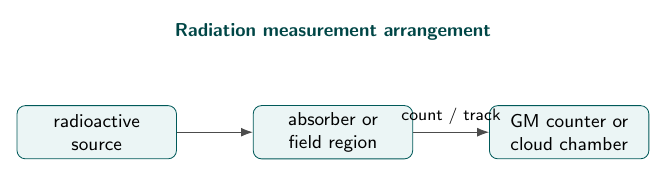
Sealed radioactive source, GM tube, scaler, high-voltage supply, absorber, and stopwatch.
Figure
Theory
If each undecayed nucleus has the same probability $\lambda$ of decaying per unit time, then $dN/dt=-\lambda N$. Integration gives $N=N_0e^{-\lambda t}$. The half-life is $t_{1/2}=\ln2/\lambda$.
Observations
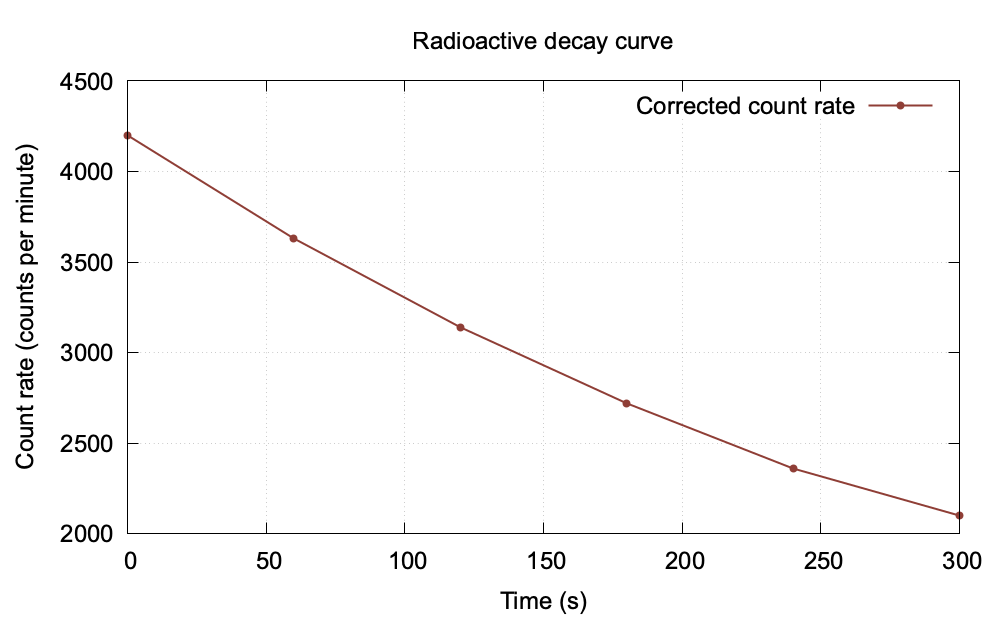
| Time (s) | Corrected count rate (counts min$^{-1}$) |
|---|---|
| 0 | 4200 |
| 60 | 3630 |
| 120 | 3140 |
| 180 | 2720 |
| 240 | 2360 |
| 300 | 2100 |
Graph
Result
The sample decay gives $t_{1/2}=300\,\text{s}$ and $\lambda=2.31\times10^{-3}\,\text{s}^{-1}$.
Viva Questions
- Why subtract background count? It is not due to the source.
- What is the GM plateau? The high-voltage range in which count rate is nearly stable.
- Why is decay random? The exact decay time of an individual nucleus cannot be predicted.


Discussion