

13 Jul 2026
Determination of g by a Simple Pendulum
practical
ug-vii
mechanics
simple-pendulum
gravity
Aim
To determine the acceleration due to gravity using a simple pendulum.
Apparatus
Small spherical bob, light inextensible string, rigid support, metre scale, stopwatch, and plumb line.
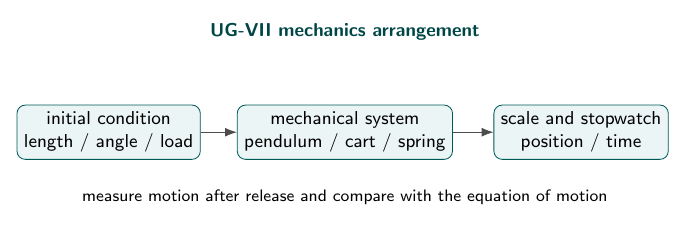
Figure
Theory
When the bob is displaced through a small angle, gravity has a tangential component that tends to restore it to the equilibrium position. For small angle $\theta$, $\sin\theta\approx\theta$, so the motion is simple harmonic and
\[T=2\pi\sqrt{\frac{l}{g}}.\]Thus a graph of $T^2$ against $l$ is a straight line of slope $4\pi^2/g$.
Observations
| $l$ (m) | Time for 20 oscillations (s) | $T$ (s) | $T^2$ (s$^2$) |
|---|---|---|---|
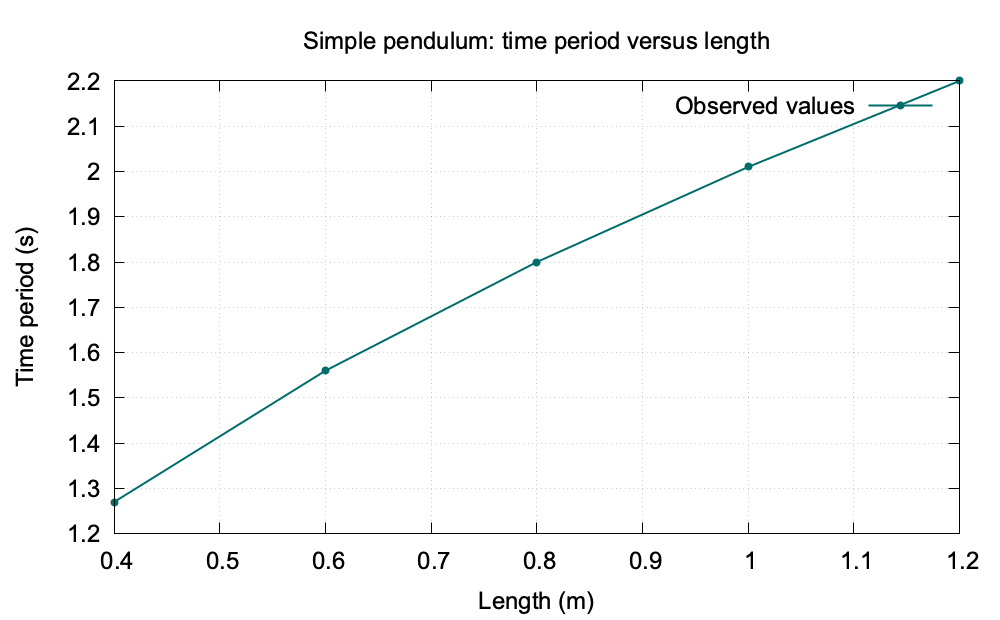
| 0.40 | 25.4 | 1.27 | 1.613 |
| 0.60 | 31.2 | 1.56 | 2.434 |
| 0.80 | 36.0 | 1.80 | 3.240 |
| 1.00 | 40.2 | 2.01 | 4.040 |
Graph
Result
From the mean period at $l=1.00\,\text{m}$,
\[g=\frac{4\pi^2l}{T^2}=9.79\,\text{m s}^{-2}.\]Viva Questions
- Why is the amplitude kept small? To make the small-angle approximation valid.
- What is the effective length? The distance from suspension point to the bob’s centre.
- Why time many oscillations? To reduce reaction-time error.


Discussion