

13 Jul 2026
Magnetic Field of a Solenoid Using a Hall Probe
practical
ug-vii
electromagnetism
solenoid
hall-probe
Aim
To determine the magnetic field inside a solenoid and verify its proportionality to current.
Apparatus
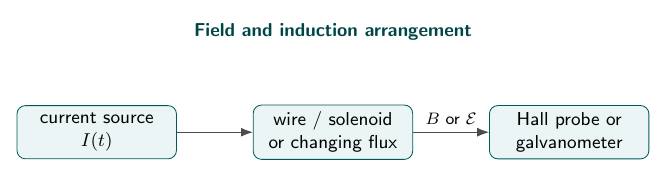
Solenoid, regulated current supply, Hall probe, Gauss meter, ammeter, and connecting wires.
Figure
Theory
For a long solenoid, the fields of its turns add inside the coil and largely cancel outside. If $n$ is the number of turns per unit length and $I$ is the current,
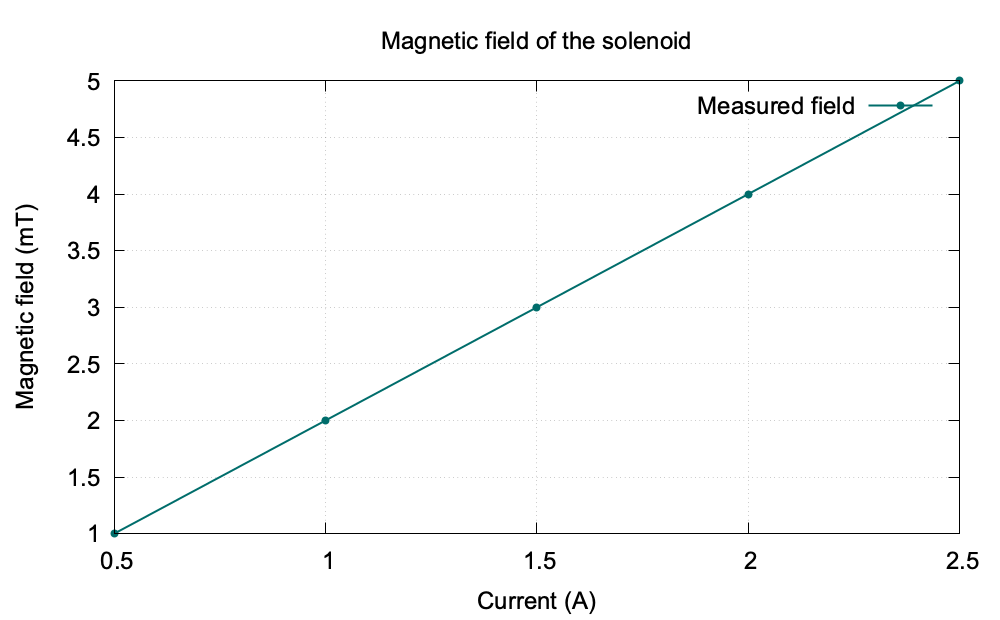
\[B=\mu_0nI.\]Therefore a plot of $B$ against $I$ should be linear and its slope gives the field produced per ampere.
Observations
| $I$ (A) | $B$ (mT) |
|---|---|
| 0.5 | 1.0 |
| 1.0 | 2.0 |
| 1.5 | 3.0 |
| 2.0 | 4.0 |
| 2.5 | 5.0 |
Graph
Result
The field-current slope is $2.0\,\text{mT A}^{-1}$, confirming $B\propto I$.
Viva Questions
- Why is the field nearly uniform inside? Contributions from many turns add symmetrically.
- Why use a Hall probe? It measures magnetic field without disturbing the coil appreciably.
- What happens outside a long solenoid? The field is comparatively weak.


Discussion