

13 Jul 2026
Refractive Index of a Dielectric Layer by Surface Plasmon Resonance
practical
ug-viii
surface-plasmon-resonance
refractive-index
Aim
To determine the refractive index of a dielectric layer from the resonance-angle shift in an SPR arrangement.
Apparatus
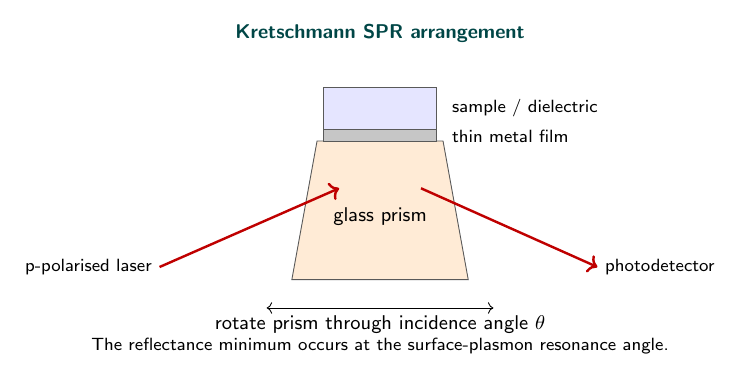
Laser, prism coupler, metal-coated slide, dielectric layer, photodetector, rotation stage, and computer interface.
Figure
Theory
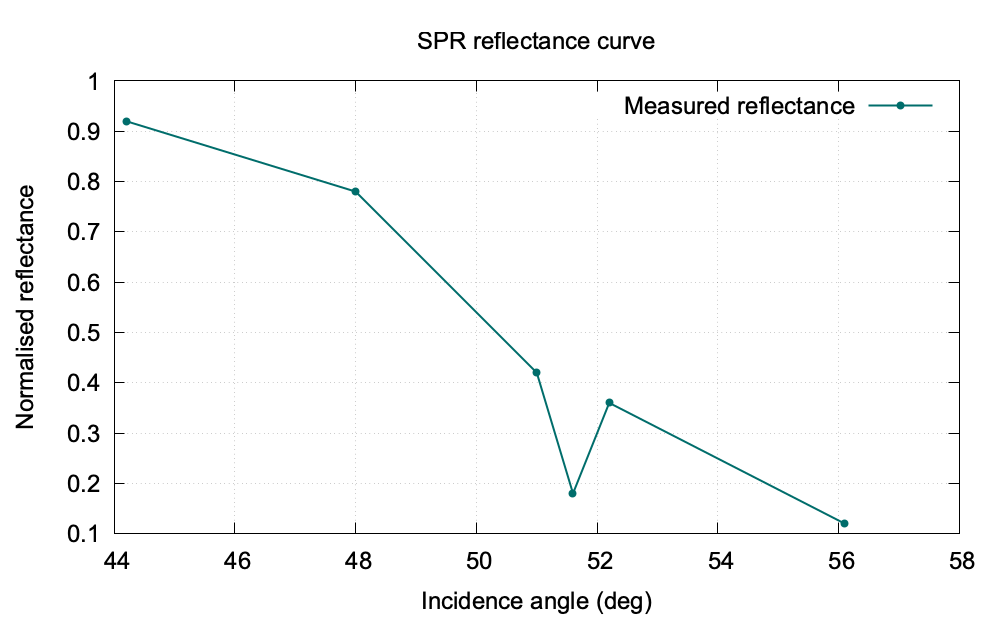
At a particular angle, the parallel component of the p-polarised wave vector matches the surface-plasmon wave vector. The reflected intensity then shows a minimum. A dielectric layer changes the interface optical environment and shifts the minimum from $\theta_0$ to $\theta_r$.
Observations
| Sample | Resonance angle | Refractive index |
|---|---|---|
| Air reference | $44.2^\circ$ | 1.000 |
| Water | $51.6^\circ$ | 1.333 |
| Unknown dielectric layer | $56.1^\circ$ | 1.510 |
Graph
Result
The refractive index of the unknown dielectric layer is
\[\boxed{n=1.510}.\]Viva Questions
- Why is p-polarised light used? It has an electric-field component normal to the interface.
- What does the resonance angle indicate? The phase-matching condition at the metal-dielectric interface.
- Why is air used as a reference? It provides a known baseline for the resonance shift.


Discussion