

13 Jul 2026
Zeeman Effect in Mercury Using a Fabry-Perot Interferometer
practical
ug-viii
zeeman-effect
spectroscopy
fabry-perot
Aim
To observe the magnetic-field splitting of a mercury spectral line and determine the spectroscopic splitting parameter.
Apparatus
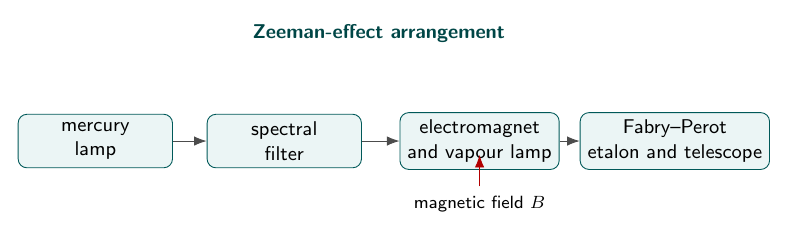
Mercury vapour lamp, electromagnet, Fabry-Perot etalon, optical filters, spectrometer, and Gauss meter.
Figure
Theory
An atomic magnetic moment has an interaction energy with an applied field. Degenerate magnetic sublevels therefore separate, and a spectral line splits into components. For a measured wavenumber separation $\Delta\bar\nu$,
\[\Delta E=hc\Delta\bar\nu=g\mu_BB.\]The Fabry-Perot etalon resolves the close components through interference of repeated transmitted beams.
Observations
| Magnetic field (T) | Ring separation | Wavenumber splitting (m$^{-1}$) |
|---|---|---|
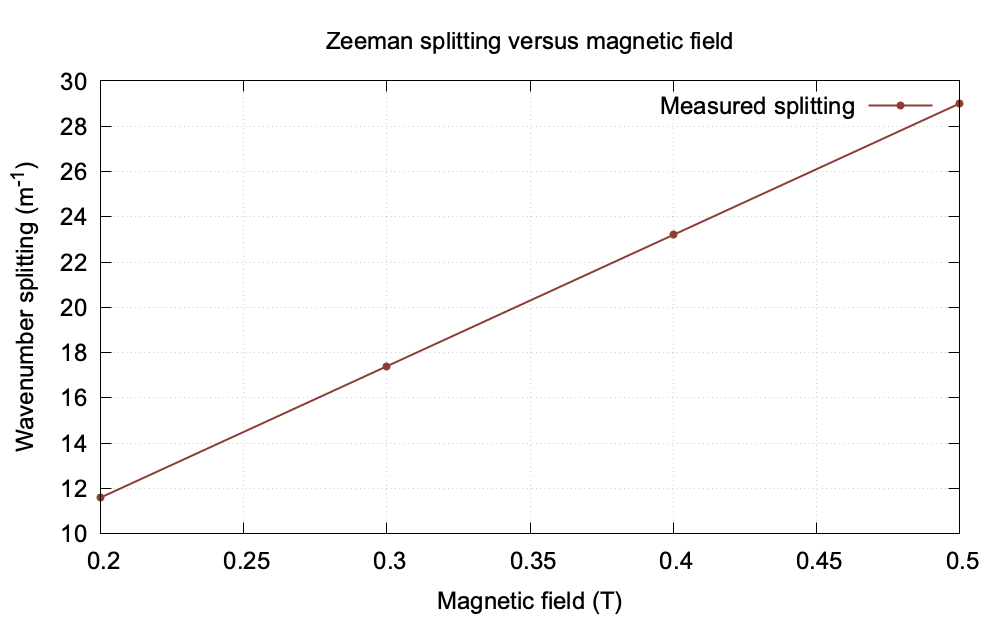
| 0.20 | 2.1 | 11.6 |
| 0.30 | 3.2 | 17.4 |
| 0.40 | 4.3 | 23.2 |
| 0.50 | 5.4 | 29.0 |
Graph
Result
The splitting increases linearly with magnetic field. The measured slope gives $g\approx2.00$ for the selected mercury line.
Viva Questions
- Why is a Fabry-Perot etalon used? It has high resolving power for closely spaced spectral components.
- What causes the splitting? Interaction of the atomic magnetic moment with the applied field.
- What is hyperfine splitting? Additional splitting due to interaction with nuclear angular momentum.


Discussion