

Chapter 7
7Compounding
Compounding explains why disciplined investing rewards amount, return, time, reinvestment, early action, and patience. The chapter follows that order because each variable feeds the next: principal is the base, return is the rate, time is the exponent, and reinvestment keeps the loop closed.
Billionaire stories are useful only when they reveal mechanism. Warren Buffett, Charlie Munger, and Rakesh Jhunjhunwala became famous not because one trade worked, but because capital, patience, and judgment were allowed to compound for decades.
Principal
Example: a first SIP of INR 5,000 looks small, but it is the seed on which every future return acts. In early years, disciplined saving often contributes more to wealth than market performance.
Principal is the capital base on which return acts.
Early in the journey, principal comes mainly from savings. Later, growth can become a major contributor.
Build the base.
- Build principal through regular surplus.
- Do not delay investing while waiting for a large lump sum.
- Protect principal meant for near goals.
Return
Example: a Nifty index fund, an actively managed equity fund, and a fixed deposit can all report returns, but each return comes from a different engine and risk. Comparing them without risk and tax is like comparing velocities without direction.
Return is the rate at which capital grows or shrinks over a period.
Small differences in return become large over long time, but higher expected return usually comes with higher uncertainty.
Adequate beats exciting.
- Prefer sustainable return over exciting return.
- Compare return after cost and tax.
- Never evaluate return without risk.
Time
Example: an investor starting at age 25 with a modest SIP can need less monthly capital than someone starting at 40 for the same retirement target. Time performs work that later effort must otherwise replace.
Time is the exponent in compounding. It is difficult to replace because lost years require much higher savings or risk later.
Repeated multiplication
In long horizons, time converts regular investing into large outcomes through repeated multiplication.
Start early
- Start before conditions feel perfect.
- Let long-term investments remain invested.
- Do not interrupt compounding for non-essential consumption.
Reinvestment
Example: choosing growth options in mutual funds lets dividends and gains remain inside the compounding machine. Withdrawing every profit for spending breaks the feedback loop.
Reinvestment means returns are put back into the investment so they can earn further returns.
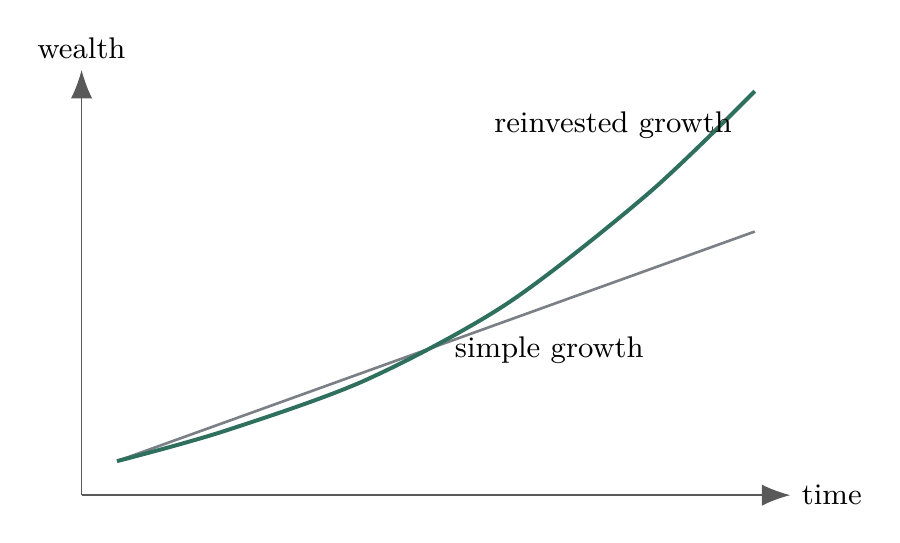
Taking gains out early weakens the feedback loop and turns compounding closer to simple interest.
Keep the loop closed
- Reinvest dividends or choose growth options for accumulation goals.
- Avoid frequent profit withdrawal from long-term assets.
- Let gains become new principal.
1965 - Berkshire Hathaway control
Warren Buffett took control of Berkshire Hathaway, then gradually shifted the company away from weak textile economics toward insurance, operating businesses, and long-term investments. The lesson is capital allocation: compounding needs retained capital and repeated intelligent deployment.
Early investing
Example: Rakesh Jhunjhunwala's public story is often remembered through large positions, but the deeper lesson is early participation in Indian businesses and decades of holding power. Early action gives good ideas room to become material.
Early investing gives capital more cycles to multiply. The advantage is structural, not motivational.
Exponent beats delay
A small amount invested early can compete with a larger amount invested late because time multiplies both principal and return.
Begin with available surplus.
- Begin with available surplus, however small.
- Increase investment as income rises.
- Do not postpone learning through action.
1985 - Rakesh Jhunjhunwala starts investing
Rakesh Jhunjhunwala began investing in Indian equities with modest capital and built wealth over decades. His later Titan holding became a symbol of conviction, but the real lesson is broader: a few durable ideas held through time can dominate many small trades.
Patience
Example: a long-term equity investor may spend years seeing little movement, then a short period can create a large part of total gain. Patience is the willingness to stay with a valid process before the curve becomes visible.
Patience is allowing the compounding process to complete enough cycles.
Markets do not reward every month, but they can reward disciplined decades. Compounding is slow first and visible later. Do not exit before curvature.
- Judge long-term assets over long-term periods.
- Ignore short-term underperformance if the plan remains valid.
- Use patience as a rule, not a mood.
1982 - Start of a long US equity bull market
After years of high inflation and weak sentiment, US equities entered a long expansion. The lesson is not to predict such starts, but to notice that compounding often becomes visible only after difficult periods.

